English
 中文
中文 Español
 русский
 français
 português
 العربية
 Deutsch
 italiano
 한국어
한국어 Polska
×
Underground tunneling projects demand drilling tools that deliver precision, reliability, and high performance in confined spaces, variable rock conditions, and challenging environments. From drill-and-blast methods to support installation, the right selection of tools directly impacts advance rates, safety, and overall project costs.
Successful tunneling requires balancing power, accuracy, and durability. Key considerations include limited workspace, ground stability, water inflow, and the need for consistent hole quality for blasting or rock bolting.
Most underground tunneling relies on the drill-and-blast cycle or mechanical excavation. In drill-and-blast operations, multi-boom jumbos equipped with high-performance rock drills create precise blast hole patterns. These jumbos allow simultaneous drilling on multiple faces, significantly improving cycle times in narrow tunnels.
For longer holes or specific geological conditions, top hammer drilling systems remain popular due to their mobility and efficiency in medium-hard rock. In harder or more abrasive formations, complementary tools help maintain straightness and penetration rates while minimizing deviation.
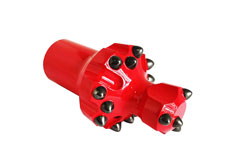
High-quality drill bits, drill rods, and shank adapters form the core of any effective underground setup. Button bits with optimized carbide inserts provide excellent penetration and longevity in abrasive rock. Threaded connections must withstand repeated high-impact stress without failure.
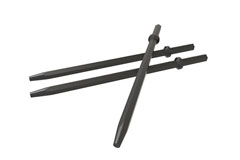
Drill rods need sufficient rigidity to transmit energy efficiently over distance while resisting bending in confined booms. Shank adapters serve as the critical link, absorbing shock and ensuring compatibility with various rock drill models.
In water-bearing zones, tools that maintain flushing efficiency and resist jamming become especially valuable. Additives that reduce torque and vibration can further extend component life in continuous underground operations.
Multi-boom drill jumbos: Ideal for face drilling in tunnel headings, offering precise alignment and rapid repositioning.
Top hammer rock drills: Suited for development drifting and benching, delivering strong impact energy with good mobility.
Pneumatic or hydraulic plugger and stoper drills: Useful for secondary drilling, roof bolting, or smaller-scale tunneling tasks in restricted areas.
Long-hole drilling rigs: Enable accurate drilling for ring patterns or cable bolting in larger tunnel sections.
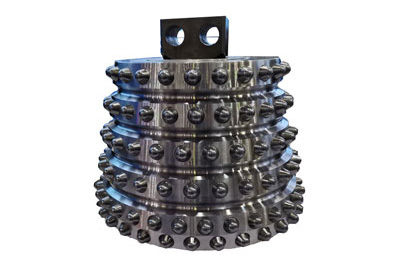
Raise boring and TBM-compatible cutters: Applied in shaft sinking or mechanized tunneling sections where continuous excavation is feasible.
Selecting tools with superior wear resistance and easy maintenance helps reduce downtime in remote underground sites.
As a trusted drilling tools manufacturer, Litian develops components specifically engineered for the demanding conditions of underground tunneling.
Rock hardness and abrasiveness dictate bit design and carbide grade. Tunnel cross-section size influences boom configuration and rig compactness. Water management requires effective flushing systems to prevent stuck rods.
Safety features, such as vibration damping and ergonomic controls, protect operators during long shifts. Compatibility across the tool string ensures energy transfer remains efficient from the hammer to the bit.
Regular inspection of threads, flushing holes, and carbide wear extends service intervals. Proper re-sharpening of bits and correct torque settings during assembly prevent premature failures. In underground environments, spare parts availability and quick-change designs provide significant advantages.
Q: What makes a drilling tool suitable for underground tunneling compared to surface mining?
Underground tools must prioritize compactness, vibration control, and reliability in limited space and variable groundwater conditions, while maintaining high precision for blast patterns and rock support.
Q: How do top hammer drilling tools perform in tunneling projects?
Top hammer systems excel in development drifting and medium-length holes due to their mobility and effective energy transmission. They pair well with multi-boom jumbos for fast cycle times in many tunnel constructions. Explore high-performance rock drilling tools designed for these applications.
Q: What role do stone drilling tools play in quarrying versus tunneling?
While tunneling focuses on controlled excavation and support, stone drilling tools in quarrying emphasize high-volume production and aggregate extraction. Both benefit from durable carbide designs but differ in rig setup and hole patterns. For details on quarrying applications, see our guide on stone drilling tools.
Q: How can water inflow affect tool selection in underground tunnels?
High water pressure can cause hole collapse or rod sticking. Tools with superior flushing channels and compatible additives help maintain penetration rates and prevent downtime in wet conditions.
This is the first one.

Litian is a professional manufacturer focused on the production of rock drilling tools and excavation tools.
Learn More >