English
 中文
中文 Español
 русский
 français
 português
 العربية
 Deutsch
 italiano
 한국어
한국어 Polska
×
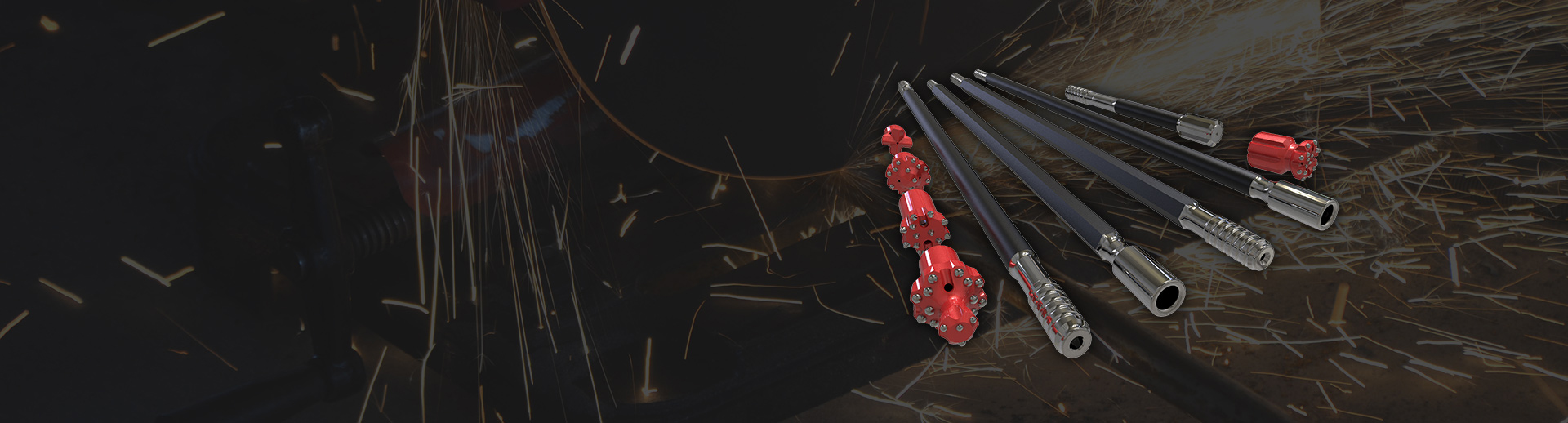
Drill rod, also known as hydraulic rock drill rod, heavy duty drill rod in top hammer rock drilling. The threaded drill rod for sale is connected with shank adapter and drill bit through the threads on both sides of the rod body, and transmits the impact energy and torque of the hydraulic rock drill to the drill bit for rock drilling. If you're looking for high-quality drill rod factories for your rock drilling needs, look no further than our selection of rock drill rods, expertly crafted and rigorously tested to ensure optimal performance and durability.
To improve the efficiency and quality of rock drilling, the rock drill rods for sale are a crucial piece of rock tools, which is why you cannot compromise on quality. As a mature rock drill rod factory, Litian offers durable and best quality mining drill rod, tunneling drill rod for sale, borehole drilling rod at affordable prices, which is a key factor in ensuring rock drilling quality. A wide range of top hammer rods is offered by Litian including R25 drill rod, R32 drill rod, T38 drill rod, T45 drill rod, T51 drill rod, ST58 drill rod, etc. Check below to get more about our rock drilling rods.
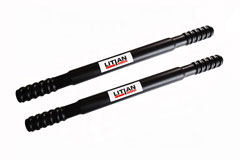
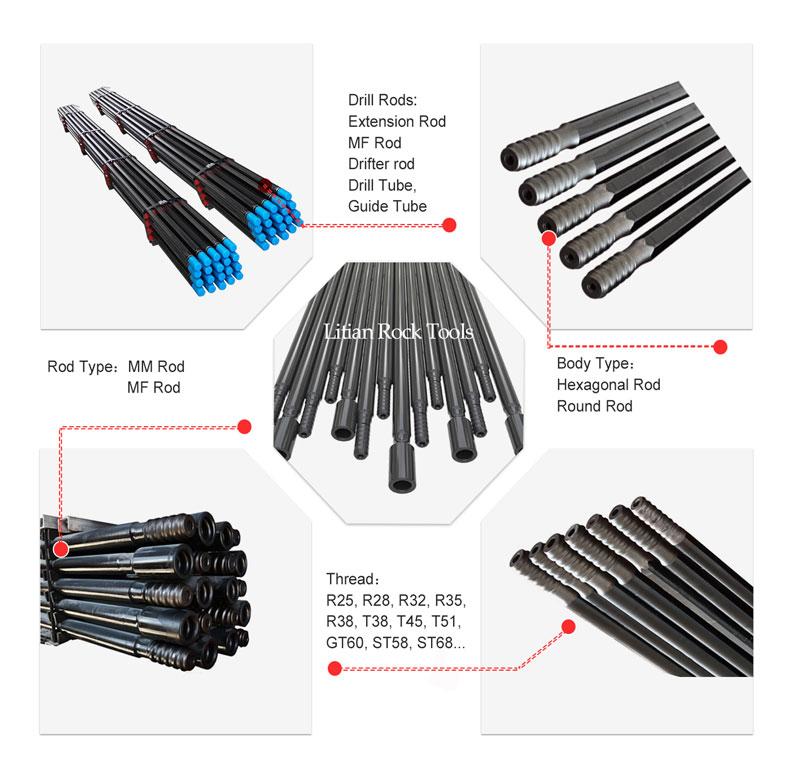
Extension rod, with male threads at both ends,connects with a shank adapterthrough a coupling sleeve. It can divide into round extension rods and hexagonal extension rods.
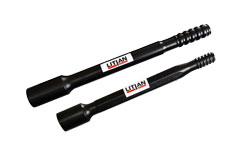
MF rod, also known as speedrod, features a male thread at one end and a female thread at the other end. It can directly connect to the shank adapter without the aid of a coupling sleeve.
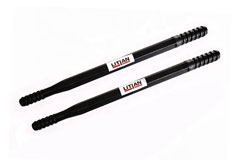
Drifter rod is mainly used on the full hydraulic drifting jumbo. It can be used for roadway excavation blasting and anchor hole drilling in underground mine.
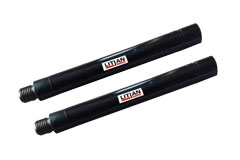
In top hammer drilling, guide tube and drill tube are mainly used for surface bench drilling and underground long hole drilling. We can provide T38 guide tube, T45 guide tube, and T51 guide tube.
Product | Top Hammer Rock Drilling Tool (rock drilling tools) - Drill Rod |
Other Names | top hammer drill rod, threaded drill rod, rock drill rod, mining drill rod, thread rock drill rod |
Material | Structural Alloy Steel |
Application | Tunnelling, Mining, Quarrying, Blasting and Infrastructure Construction Facedrilling and Bolting, Bench Drilling, Production drilling, Long hole drilling, Drifting |
Thread | R22, R25, R28, R32, R35, R38, T38, T45, T51, GT60, ST58, ST68, SR28, SR35, EL60, EL68, etc. |
Rod Type | MM rod (Male/Male thread): Extension rod, Drifter rod MF rod (Male/Female thread): Speedrod, MF drifter rod Drill tube, Guide tube |
Body Type | Hexagonal drill rod, Round drill rod |
Diameter | 20mm~87mm |
Length | 260mm~6400mm |
Custom Design | Acceptable |
| Rod / Pipe Size | Typical OD | Typical Hole Diameter | Mining Application |
| 2 ⅜ in | ~60 mm | 90–110 mm | Small DTH drilling, quarrying |
| 2 ⅞ in | ~73 mm | 110–130 mm | Medium DTH mining applications |
| 3 ½ in | ~89 mm | 130–165 mm | Large DTH holes, surface mining |
| 4 in | ~102 mm | 165–203 mm | Heavy surface mining and blasting |
Our drill rods adopt a complete set of mature technology such as advanced surface treatment technology, smelting technology, and mechanical processing technology, which greatly reduces the loss of energy in transmission and makes the drilling speed very fast. We have advanced thread manufacturing technology, which can effectively reduce the risk of indentation and fracture at the thread end, making it easier to connect and disassemble drill rods, drill bits and shank adapters, resulting in shorter downtime, straighter drilling holes and higher production efficiency. The escrape groove in the transition area between the thread and the rod body is the weakest area of the drill rod, where the drill rod section is the smallest, not only to bear the high-frequency tensile and compressive normal stress, high torsional stress, but also to withstand the additional bending stress caused by the weight of the drill rod and the rock drilling operations. In drilling practice, Litian continuously optimizes the processing technology of the escrape groove, and has our own unique processing technology, which has minimized the risk of breakage at the escrape groove.
As a professional drill rod manufacturer, we strictly control all aspects of production to ensure that high-quality drill rods are presented to customers.
A drill rod is a critical component in drilling systems, used to connect the drilling machine to the drill bit and extend the drilling depth while maintaining control, power transmission, and stability throughout the drilling process.
In practical terms, a drill rod performs several essential functions:
First, it transmits rotational torque and thrust from the drilling machine to the drill bit. As the drilling depth increases, additional drill rods are added to the string, allowing the bit to penetrate deeper into rock, concrete, or other materials without losing power or alignment.
Second, the drill rod maintains hole direction and straightness. High-quality drill rods are manufactured with precise dimensions and strong threaded connections to reduce bending, vibration, and deviation, which is especially important in deep drilling, mining exploration, and construction coring.
Third, drill rods often serve as a conduit for flushing media, such as water, air, or drilling fluid. This flushing removes cuttings from the hole, cools the drill bit, reduces friction, and improves drilling efficiency while preventing tool damage or hole blockage.
In mining and geological drilling, drill rods also play a role in protecting downhole tools by absorbing stress and distributing loads evenly along the drill string. In construction drilling, they help maintain accuracy and stability when drilling through concrete or reinforced materials.
Overall, a drill rod is not just an extension piece—it is a structural and functional component that directly affects drilling performance, hole quality, tool life, and operational safety.
Most drill rods are manufactured from high-quality alloy steels, specifically formulated to withstand high torque, impact energy, and cyclic loading. High-strength alloy steels containing elements such as chromium, molybdenum, and nickel are widely used in mining and construction drilling.
Key characteristics:
High tensile strength
Good toughness and fatigue resistance
Suitable for heat treatment
Balanced wear resistance and ductility
Alloy steel drill rods are commonly used in:
Underground mining
Surface mining and quarrying
Construction rock drilling
Typical Hardness Requirements for Drill Rods
| Drill Rod Area | Typical Hardness Range (HRC) | Purpose |
| Rod Body | 35–45 HRC | Provides toughness and fatigue resistance |
| Thread Area | 45–55 HRC | Improves wear resistance and thread life |
| Pin / Shank End | 48–55 HRC | Handles high impact and torque loads |
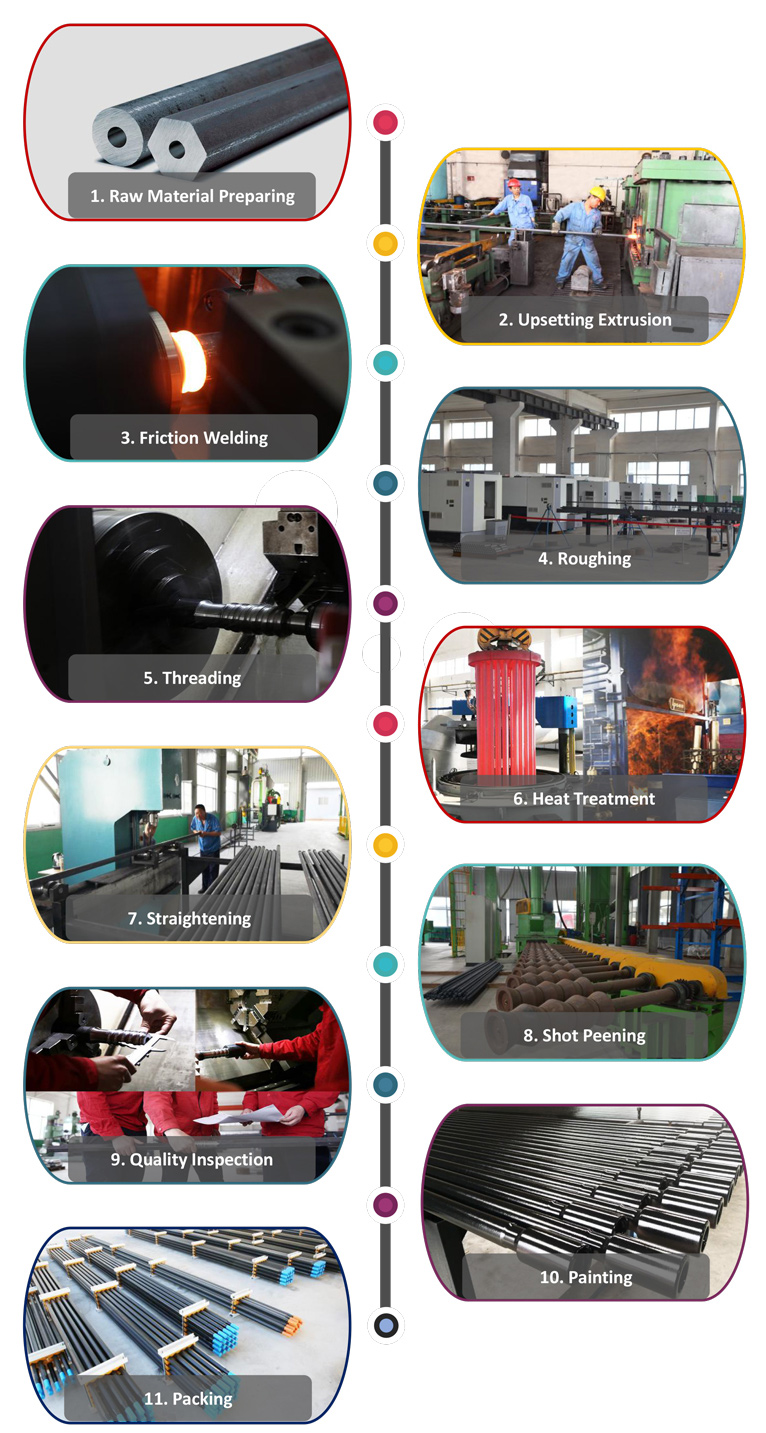

Litian top hammer drill rod is made of high-quality alloy structure hollow rock drill steel (high chromium-molybdenum-nickel alloy steel) as raw material, its proof strength Rp0.2 is 900MPa-1000MPa, tensile strength Rm is 1250MPa-1350MPa, and hardness is 37-44 HRC. Our drill rods have the advantages of high wear resistance, high fatigue strength, high toughness, and long service life.
Drill Rod HS Code: 7228.30
Description: Other alloy steel bars and rods, not further worked than hot-rolled, hot-drawn or extruded
Drill rod service life depends on rock abrasiveness, drilling parameters, maintenance practices, and proper matching with bits and coupling sleeves.
Common causes include excessive impact energy, poor thread lubrication, mismatched components, improper hardness, and drilling in highly abrasive or deviated holes.
Drill rods should be cleaned, properly lubricated at threads, inspected for wear or cracking, and stored to prevent corrosion and thread damage.
Proper hardness improves wear resistance and thread life, while maintaining enough toughness to prevent cracking or fatigue failure during drilling.
Drill rods are typically designed for specific drilling methods such as top hammer, DTH, or core drilling, and should not be mixed across systems without compatibility checks.


Litian is a professional manufacturer focused on the production of rock drilling tools and excavation tools.
Learn More >