English
 中文
中文 Español
 русский
 français
 português
 العربية
 Deutsch
 italiano
 한국어
한국어 Polska
×
Quarry drilling is the foundation of every successful aggregate operation. The quality of the drilling program determines the accuracy, efficiency, and performance of every blast that follows. In a high-volume, low-unit-value industry like crushed stone production, optimizing drilling operations is not optional—it is essential for profitability.
This guide covers the essential quarry drilling equipment and rock drilling tools you need to know, from rig types and drill bits to maintenance practices that extend tool life and reduce cost per meter.
Production drilling in the construction aggregate industry is performed with percussive or rotary drills. Percussive drilling is the most common method in aggregate operations, encompassing both top hammer and down-the-hole (DTH) hammer systems.
| Factor | Top Hammer Drilling | DTH Drilling |
| Hammer position | Above the rod string at the surface | At the bottom of the hole, directly above the bit |
| Typical hole diameter | Under 4 inches (100 mm) | Over 4 inches (100 mm) |
| Optimal depth | Shallow holes, typically under 50 ft (15 m) | Deep holes, maintains straightness beyond 50 ft |
| Hole straightness | Deviation increases with depth | Excellent, even at depth |
| Primary quarry use | Bench drilling, smaller diameter blast holes | Large-diameter blast holes, hard rock formations |
Top hammer drilling is widely used in quarrying operations, particularly for bench drilling and production drilling. In a top hammer drill, percussive energy is delivered from a hammer mounted above the rod string. As the hole deepens, additional drill steels are added—but the hammering continues from the top.
Top hammers are fast and effective for shallow holes, typically under 50 ft, and are generally used for hole diameters under 4 inches. However, they become less efficient with depth or drill diameter. As the drill string lengthens, energy transmission degrades, alignment suffers, and deviation increases.
Top hammer drilling tools remain the industry standard for high-speed production, precise alignment, and versatility in medium to hard rock formations.
DTH hammers place the hammering mechanism directly above the drill bit. Percussive energy is delivered at the bottom of the hole, and additional steels are stacked above the hammer as depth increases. This allows DTH rigs to maintain straighter holes and more consistent penetration rates, especially beyond 50 ft.
DTH drilling is most often used for hole diameters over 4 inches. In quarry applications, DTH rigs are commonly used for bench drilling, pre-splitting, and controlled blasting. For the most common quarry application—using a 115mm (4.5-inch) bit in hard granite—the optimal rotation speed is typically between 25 and 35 RPM.
Rotary drills are less common in quarry production but are occasionally used in specific conditions. They function by grinding the rock with a rotating bit under high weight-on-bit, without percussive action. Rotary rigs are typically used for larger hole diameters and can be beneficial in very abrasive formations or sandy formations where maintaining borehole integrity is critical.
A high-performing top hammer drilling system relies on perfect structural synchronization between three primary components: the shank adapter, the drill rod, and the button bit.
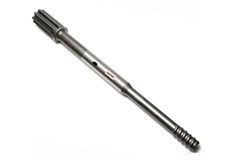
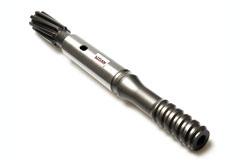
The shank adapter transmits rotational torque, feed force, and high-frequency impact energy from the rock drill drifter directly to the drill rods. It withstands millions of high-stress impacts per shift, requiring superior metallurgy and precise machining.
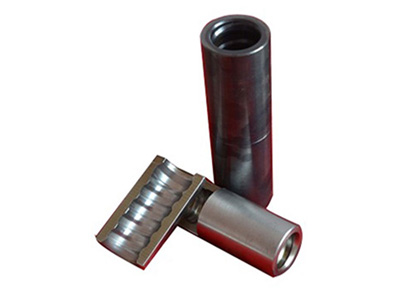
Drill rods must exhibit excellent fatigue strength and flexibility to prevent bending under heavy feed pressure. Common thread profiles used in quarry drilling include R32, T38, T45, and T51. For automated mechanized drilling rigs, long-hole extension rods with specialized T-threads offer superior rigid guiding and tighter joints, minimizing hole deviation.
The selection of the drill bit design determines penetration rate. Depending on the rock geology—whether highly abrasive granite or soft limestone—operators must select the correct carbide shape and face design.
Button shapes:
Ballistic buttons: Offer rapid penetration in soft-to-medium formations
Spherical (domed) buttons: Offer unmatched structural durability in highly fractured, abrasive hard rock
Face configurations:
Drop-center faces: Provide exceptional hole straightness in homogeneous rock
Flat-face profiles: Ideal for extreme hardness where tool body washing must be resisted
Reaming bits are specialized tools used to enlarge an existing pilot hole to a larger diameter. In underground quarry blasting operations, after blastholes are drilled with diameters of 43–51 mm, certain holes in the blast pattern are enlarged to 76–102 mm using a reaming bit. These enlarged holes are left unloaded, creating voids that enable the surrounding rock to implode more effectively during detonation.
Different rock types demand different drilling tools. Understanding rock hardness and abrasiveness is essential for selecting the right equipment.
| Rock Type | UCS Range | Key Consideration | Recommended Tool |
| Limestone | 50–100 MPa | Relatively soft; low abrasiveness | Standard button bits with parabolic buttons |
| Sandstone | 80–150 MPa | Highly abrasive; quartz-rich | Ballistic button bits for rapid penetration |
| Granite | 150–250 MPa | Hard; low to medium abrasiveness | Spherical button bits for durability |
| Basalt | 150–250 MPa | Hard; variable abrasiveness | Spherical button bits |
Drilling tools that perform well in soft limestone may wear rapidly in highly abrasive granite, while a configuration designed for hard rock may lead to unnecessary energy consumption and reduced drilling efficiency in softer formations.
Surface drill rigs for quarrying come in various configurations:
Crawler-mounted hydraulic drill rigs: Common in small and medium-sized quarries for rock blasting and drilling
Track-mounted top hammer drills: Hole diameters of 2.5 to 5 inches (64–127 mm)
DTH track drills: For larger diameter holes and deeper benches
Dimensional stone quarries require specialized equipment for line drilling, splitting, and squaring. Typical hole diameters range from 22–45 mm for trimming operations to 45–89 mm for pilot hole drilling.
For precision applications such as line drilling in dimensional stone quarries, small hole drilling tools—including tapered button bits, tapered drill rods, and integral drill rods—are essential.
In aggregate production, rock drilling equipment operates under relentless conditions—dust, vibration, and continuous impact stress accelerate wear and increase failure risks.
Bit inspection: Examine button height, gauge diameter, and face washing. Replace bits with >30% button wear or visible cracks
Flushing system: Clear all holes with compressed air. Blockages cause overheating and premature failure
Thread condition: Check rod and coupling threads for galling, stretching, or debris packing
Shank adapter: Inspect striking face for mushrooming or cracking—replace immediately if damaged
Thorough cleaning prevents particle accumulation:
Disassemble rod strings completely
Soak components in degreaser to remove packed dust
Use wire brushes on threads and flushing channels
Apply thread compound before reassembly
Rock drilling tools properly cleaned weekly maintain 20–25% longer service life compared to neglected equipment.
Store quarrying tools vertically in dry, covered areas
Use thread protectors on all connections
Rotate inventory FIFO to prevent corrosion
Handle with slings, not chains, to avoid surface damage
Drilling and blasting operations typically account for 20–25% of total unit cost in quarrying. Even small optimizations can yield significant savings.
Research has shown that:
Incrementing blasthole diameter from 89 to 102 mm reduced total unit cost by $0.091/m³
Incrementing burden and spacing by 0.25 m decreased total unit cost by $0.097/m³
A blasthole length of 15 m ensured optimum fragmentation, diminishing costs of subsequent operations
In one case study, customized drill tools resulted in a 24% increase in average drilling speed, a 37% reduction in bit replacement frequency, and a 29% decrease in cost per meter drilled.
Another study found that a more cost-effective drill hole pattern—with a hole diameter of 89 mm, burden of 2.5 m, and spacing of 3.5 m—reduced operational expenses by as much as 8.5%.
Quarry drilling is not a commodity service—it is a technical discipline that demands precision, consistency, and geological awareness. Poorly drilled holes create inconsistent burdens, irregular fragmentation, and costly downstream problems.
The key takeaways for optimizing quarry drilling operations:
Match the drilling method to the application—top hammer for holes under 4 inches and shallow benches; DTH for larger diameters and deeper holes
Select tools by rock type—spherical buttons for granite, ballistic for sandstone, parabolic for limestone
Maintain equipment rigorously—daily inspections, weekly deep cleaning, and proper storage extend tool life by 20–25%
Optimize blasthole design—diameter, burden, and spacing directly impact total cost
Track cost per meter—the most meaningful metric for evaluating drilling performance
Whether you are operating a large-scale aggregate quarry or a dimensional stone operation, the right drilling equipment and tools—combined with disciplined maintenance and data-driven optimization—will keep your production on track and your costs under control.
Q1: What is the main difference between top hammer and DTH drilling in quarries?
In top hammer drilling, the hammer is mounted above the rod string at the surface, delivering energy through the rods. In DTH drilling, the hammer is at the bottom of the hole directly above the bit. Top hammer is faster for shallow holes under 4 inches in diameter, while DTH maintains straighter holes and consistent penetration rates in deeper holes and larger diameters.
Read more: What is the difference between top hammer drilling and DTH drilling?
Q2: How do I choose the right button bit for my quarry rock type?
For granite and basalt (UCS 150–250 MPa), choose spherical button bits for maximum wear resistance. For highly abrasive sandstone (UCS 80–150 MPa), choose ballistic button bits for rapid penetration. For limestone (UCS 50–100 MPa), choose drop center button bits with parabolic buttons.
Read more: How to Choose the Right Button Bit for Rock Drilling
Q3: What maintenance practices extend quarry drilling tool life the most?
Daily inspection of button wear, thread condition, and flushing systems is essential. Weekly deep cleaning—including complete disassembly, degreasing, and wire brushing of threads—extends service life by 20–25%. Proper storage in dry, covered areas with thread protectors also prevents corrosion and damage.
Read more: Maintenance Tips for Rock Drilling Equipment in Aggregate Production
Q4: What hole diameter is typical for quarry blast hole drilling?
Quarry blast hole diameters typically range from 89 mm to 102 mm for production drilling. Top hammer rigs generally handle holes under 4 inches (100 mm), while DTH rigs take over above that threshold. For dimensional stone applications, hole diameters are much smaller—typically 22–45 mm.
Q5: How can I reduce drilling costs in my quarry operation?
Optimize blasthole design parameters: increasing diameter from 89 to 102 mm can reduce total unit cost by $0.091/m³. Optimizing burden and spacing can reduce costs by $0.097/m³. Using application-specific drill tools has been shown to reduce bit replacement frequency by 37% and cost per meter by 29%.
"Drilling & Blasting – P&Q University Handbook" – Pit & Quarry (industry publication). https://stage.pitandquarry.com/drilling-blasting-pq-university-handbook/3/
"Assessment of the Effect of Blasthole Design Parameters on Total Cost in Quarries" – Karadeniz Technical University (academic research). https://gcris.ktun.edu.tr/entities/publication/185c502a-1523-4489-922d-61be7693ca02
"Evaluation of the Operational Costs Depending on the Drill Hole Patterns in a Limestone Quarry: A Case Study" – EBSCOhost (academic database). https://openurl.ebsco.com
"Experimental study on the influence of drilling parameters on penetration rate in hard rock" – ScienceDirect, 2021. https://www.sciencedirect.com
"Optimization of blasthole drilling in surface mining" – Springer (Mining, Metallurgy & Exploration), 2020. https://link.springer.com
"A review of rock drilling methods and their energy efficiency" – ScienceDirect (Renewable and Sustainable Energy Reviews), 2019. https://www.sciencedirect.com
"Influence of rock properties on drilling rate and tool wear in percussive drilling" – Taylor & Francis (Geomechanics and Geoengineering), 2022. https://www.taylorfrancis.com
"Wear mechanisms of tungsten carbide buttons in hard rock drilling" – Elsevier (Wear Journal), 2020. https://www.elsevier.com
"Performance analysis of down-the-hole hammer drilling in quarry applications" – OnePetro (SPE technical paper), 2018. https://onepetro.org
"Surface drilling rig selection for aggregate production" – ResearchGate (industry study), 2021. https://www.researchgate.net
This is the first one.

Litian is a professional manufacturer focused on the production of rock drilling tools and excavation tools.
Learn More >