English
 中文
中文 Español
 русский
 français
 português
 العربية
 Deutsch
 italiano
 한국어
한국어 Polska
×
In aggregate production, rock drilling equipments operate under relentless conditions—dust, vibration, and continuous impact stress accelerate wear and increase failure risks. Proper maintenance of quarrying drill tools is not merely preventive; it’s a critical profitability driver. This extensive guide details comprehensive maintenance protocols, inspection schedules, troubleshooting methods, and performance optimization strategies for quarry drilling operations.
Aggregate quarries generate copious fine particles that infiltrate every component of stone drilling tools. Abrasive wear dominates, with silica particles eroding steel surfaces and carbide inserts. Impact fatigue causes micro-cracks in buttons, while thermal cycling from rapid drilling creates stress concentrations.
Corrosion is another silent threat, especially in wet environments or with water-based dust suppression. Quarry equipment exposed to alternating wet/dry cycles develops pitting that compromises structural integrity. Understanding these mechanisms guides effective maintenance strategies.
Implement rigorous daily checks to catch issues early:
Bit Inspection: Examine button height, gauge diameter, and face washing. Replace bits with >30% button wear or visible cracks.
Flushing System: Clear all holes with compressed air. Blockages cause overheating and premature failure.
Thread Condition: Check rod and coupling threads for galling, stretching, or debris packing.
Shank Adapter: Inspect striking face for mushrooming or cracking—replace immediately if damaged.
Document findings in digital maintenance logs to track wear patterns and predict replacement intervals.
Thorough cleaning prevents particle accumulation:
Disassemble rod strings completely
Soak components in degreaser to remove packed dust
Use wire brushes on threads and flushing channels
Ultrasonic cleaning for precision components
Apply thread compound before reassembly
Rock drilling tools properly cleaned weekly maintain 20–25% longer service life compared to neglected equipment.
Proper lubrication is critical for quarry drills:
| Component | Lubricant Type | Application Method |
|---|---|---|
| Rod Threads | Copper anti-seize | Brush application |
| Shank Adapter | High-temp grease | Grease gun |
| Impact Piston | Manufacturer spec | Automated system |
| Rotation Gearbox | Synthetic gear oil | Level check/fill |
Over-lubrication attracts dust—apply sparingly but consistently.
Professional sharpening restores button geometry:
Use diamond grinding wheels at correct angles
Maintain original button protrusion (typically 55–60% of diameter)
Balance bit after retipping to prevent vibration
Limit retipping to 2–3 times per bit
Track sharpening history—excessive retipping reduces steel body strength.
Improper storage accelerates degradation:
Store quarrying tools vertically in dry, covered areas
Use thread protectors on all connections
Rotate inventory FIFO to prevent corrosion
Handle with slings, not chains, to avoid surface damage
Modern quarry drilling machine systems incorporate sensors monitoring:
Vibration signatures indicating bearing wear
Temperature trends showing lubrication issues
Impact energy consistency revealing piston problems
Hour meters triggering scheduled maintenance
Data analytics predict failures weeks in advance, preventing catastrophic breakdowns.
Drill Bits: Focus on button integrity and flushing efficiency. Clean after every hole in dusty conditions.
Extension Rods: Inspect for bending (maximum 1:200 straightness tolerance). Check wall thickness—replace at 10% reduction.
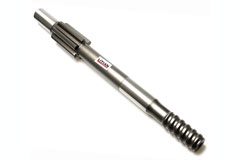
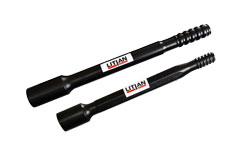
Shank Adapters: Critical failure points. Replace at first sign of cracking. Use torque wrenches for proper installation.
Couplings: Monitor wear sleeves and thread roots. Carburized couplings last 3–4 times longer than standard types.
Dust control extends equipment life:
Wet suppression systems reduce airborne particles by 90%
Enclosed cabs with positive pressure prevent dust ingress
Regular filter replacement maintains air quality
Water recycling systems minimize consumption
Maintenance excellence requires skilled operators:
Train on proper collaring techniques to prevent bit damage
Teach parameter adjustment for changing conditions
Implement standard work instructions for inspections
Use checklists to ensure consistency across shifts
Preventive maintenance costs 3–5% of equipment value annually but yields:
30–40% extension in component life
50% reduction in unplanned downtime
15–20% lower overall operating costs
Improved safety through reliable equipment
| Symptom | Likely Cause | Corrective Action |
|---|---|---|
| Slow penetration | Worn buttons/polishing | Replace/sharpen bit |
| Excessive vibration | Bent rods/unbalanced bit | Straighten/replace |
| Premature thread wear | Insufficient lubrication | Improve application |
| Overheating | Clogged flushing | Clean/increase flow |
Schedule maintenance during planned downtime:
Align with blast cycles (maintenance between blasts)
Use production gaps for deep cleaning
Plan major overhauls during seasonal slowdowns
Maintain spare parts inventory for quick swaps
Digital maintenance management systems track:
Component serial numbers and history
Meters/hours per part
Failure modes and root causes
Cost per meter trends
Data-driven decisions optimize replacement intervals and identify training needs.

Litian is a professional manufacturer focused on the production of rock drilling tools and excavation tools.
Learn More >