English
 中文
中文 Español
 русский
 français
 português
 العربية
 Deutsch
 italiano
 한국어
한국어 Polska
×
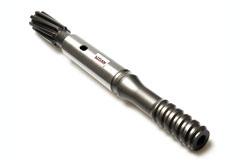
Shank adapters (also called striking bars) are the critical bridge between a rock drill and the drill string. They sit inside the drill's chuck housing, absorbing the piston's direct blows and transferring impact energy, rotation torque, feed force, and flushing medium into the drill rod and ultimately the bit. For a comprehensive look at this component's role, see our detailed guide: What Is the Function of Rock Drill Shank Adapter?
Sandvik and Atlas Copco (now Epiroc) dominate the global rock drilling equipment market, and understanding how their shank adapter ecosystems differ—and where they can cross over—is essential for any operation managing mixed fleets or sourcing aftermarket consumables.
Sandvik's numbering follows a logical pattern tied to their drifter families:
HL = Hydraulic Drifter (e.g., HL300, HL500, HL600, HL700, HL800, HL1000, HL1500)
HLX = High-performance drifting series (e.g., HLX5)
HFX = Face drilling series
RD = Rock drill series (e.g., RD520)
The number after the prefix generally indicates the power class—higher numbers mean larger, more powerful drifters requiring heavier-duty shank adapters.
Below is a compatibility reference table showing how different Sandvik drifter models map to their standard thread configurations:
| Sandvik Drifter Model | Compatible Thread Types | Typical Hole Range | Application |
| HL300 / HL300S | R32, R38 | 35–51 mm | Light drifting, bolting |
| RD520 | R32, R38, T38 | 43–64 mm | Underground development |
| HL500 / HL500S | T38, T45 | 48–76 mm | Medium drifting |
| HLX5 / HFX5 | T38, T45, T51 | 51–89 mm | High-power drifting |
| HL600 / HL600S | T38, T45 | 51–89 mm | Production drilling |
| HL700 | T38, T45, T51 | 64–102 mm | Heavy production drilling |
| HL800 | T45, T51 | 76–115 mm | Heavy-duty production |
| HL1000 | T45, T51 | 76–127 mm | Large-scale drifting |
| HL1500 | T51, ST58 | 89–152 mm | Ultra-heavy production |
Note that the same drifter model can often accept multiple thread types. For example, the HL700 works with T38, T45, and T51—but each requires a different shank adapter. The thread choice depends on the drill rod and bit system you're running, not just the drifter model. Higher-power drifters generally demand larger-diameter shanks and heavier thread systems.
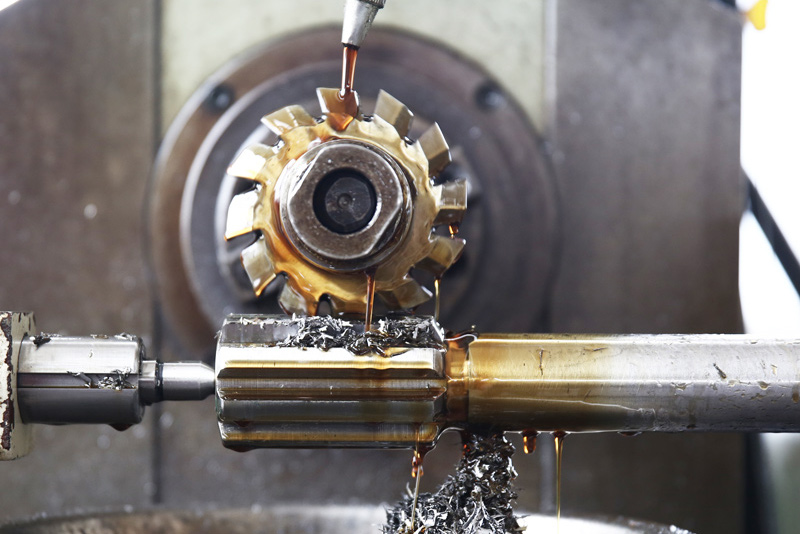
Material: Typically high-grade alloy steel, carburized and CNC-machined for precise spline tolerances. Case depth and surface hardness are tightly controlled to handle the high-frequency impact loads characteristic of Sandvik's hydraulic drifters.
Thread Options: Common R-type (R32, R38) for lighter rigs and T-type (T38, T45, T51) for medium to heavy hydraulic drills. ST-type (ST58) is available for ultra-heavy applications like the HL1500.
Corrosion Protection: Sandvik's Golden Shank series features a low-friction, nickel-plated coating with a polymer top sealant. This coating has demonstrated 30–100% longer product life in corrosive underground environments, and even in mines where corrosion is not the dominant wear factor, field tests consistently show two to three times longer performance life compared to standard shank adapters.
Litian's HL/RD/HLX series shank adapters are manufactured to OEM specifications for direct replacement in Sandvik drifters. They feature CNC-machined splines with precise tooth symmetry, alloy structural steel bodies with deep carburized case depth, and compatibility with original part numbers—including the 7804-7585 series for R38, 7304-7585 series for T38, and 7305-7586 series for T45 configurations.
Atlas Copco (Epiroc) uses two main drifter families:
COP = Hydraulic rock drills. The numbering provides clues: COP 1032, COP 1238, and COP 1440 through COP 2550 represent progressively larger drifters. Here, the first digits broadly indicate the drifter's power class, while the last two digits often reference the piston size or stroke characteristics.
BBC = Pneumatic rock drills (e.g., BBC 16, BBC 34, BBC 43 through BBC 120). These are the classic pneumatic machines, still widely used in smaller operations and where compressed air infrastructure already exists. The BBD variants add clockwise rotation for bolting applications.
| Atlas Copco Drifter Model | Compatible Thread Types | Typical Hole Range | Application |
| BBC 16/34 | R25, R28 | 27–41 mm | Light pneumatic drilling |
| BBC 43/44/45/100 | R32, R38 | 35–45 mm | Pneumatic drifting |
| BBC 51/52/54/120 | R32, R38 | 35–51 mm | Heavy pneumatic drifting |
| BBE 57 | R32, R38 | 38–51 mm | Pneumatic with extended feed |
| COP 125/130/131 | R32, R38, T38 | 38–51 mm | Light hydraulic drifting |
| COP 1032/1036/1038/1238 | R32, R38, T38, T45 | 43–76 mm | Medium hydraulic drilling |
| COP 1440/1550/1638/1838/2238 | T38, T45, T51 | 51–102 mm | High-power hydraulic drifting |
| COP 1840/1850 | T45, T51 | 64–115 mm | Heavy production drifting |
| COP 2550/4050 | T45, T51 | 76–127 mm | Ultra-heavy production |
COP Hydraulic Series: The COP design features a male thread configuration, with adapters usually made from carburized alloy steel. Surface hardness on thread flanks typically targets 58–62 HRC for optimal wear resistance. Various overall lengths and shank diameters are offered to accommodate different chuck bushing configurations and spline drive geometries across the COP model range.
BBC Pneumatic Series: These classic pneumatic shank adapters incorporate internal water tubes and flushing holes designed for the lower-impact, higher-frequency percussion characteristic of pneumatic drifters. The thread systems tend to be smaller (R32-dominant), and the overall adapter lengths are generally shorter than their hydraulic counterparts. The spline geometry differs fundamentally from COP hydraulic models, so the two cannot be interchanged.
Manufacturing Quality: Atlas Copco OEM shanks are precision-ground with tight tolerances on spline symmetry. Litian aftermarket shank adapters are CNC-machined with the same critical dimensional precision, using high-grade alloy structural steel with controlled carburizing processes to match OEM durability.
The table below provides a direct cross-reference between the most common drifter models from both manufacturers:
| Power Class | Sandvik/Tamrock Drifter | Atlas Copco/Epiroc Drifter | Common Thread Types |
| Light Hydraulic | HL300 | COP 125/130/131 | R32, R38 |
| Medium Hydraulic | HL500/HL510 | COP 1032/1036/1038 | R32, R38, T38 |
| Medium-Heavy Hydraulic | HL550/HL560 | COP 1238/1440 | T38, T45 |
| Heavy Hydraulic | HL600/HL700 | COP 1550/1638/1838 | T38, T45, T51 |
| Ultra-Heavy Hydraulic | HL800/HL1000 | COP 1840/1850/2238 | T45, T51 |
| Maximum Production | HL1500 | COP 2550/4050 | T51, ST58 |
| Pneumatic | — | BBC 16/34/43/51/120 | R25, R28, R32, R38 |
As the table shows, the thread types used by similar-class drifters from Sandvik and Atlas Copco frequently overlap. This is by design—both OEMs conform to international thread standards (R32, R38, T38, T45, T51, ST58). However, thread type alone does not guarantee compatibility.
Even when two shank adapters share the same thread designation (e.g., T45), they are built for different rock drill models and are not cross-compatible. The table below explains which features can and cannot be shared:
| Feature | Can Be the Same Across OEMs? | Notes |
| Thread type (R32, T38, T45, etc.) | ✅ Yes | Thread standards are universal; both OEMs follow ISO-compliant profiles for R and T threads |
| Spline geometry (tooth count, profile) | ❌ No | Each drifter model has a unique chuck bushing design; splines must match OEM specifications precisely |
| Overall length | ❌ No | Determined by the chuck housing depth of the specific drill model; a mismatch prevents proper seating |
| Strike face diameter & geometry | ❌ No | Must match the piston diameter and face profile of the specific rock drill model |
| Flushing tube configuration | ❌ No | Internal flushing passages differ between models, especially between hydraulic and pneumatic drifters |
This is why model-specific shank adapters are necessary: a T45-thread adapter for a Sandvik HL700 has completely different spline geometry, length, and strike face dimensions than a T45-thread adapter for an Atlas Copco COP1838. The thread designation tells you the drill rod connection, not the drifter fitment.
Given the model-specific nature of shank adapters, true cross-brand compatibility is limited. However, there are specific areas where operators can realize efficiencies:
What's Typically Possible:
Same thread -> same drill rods: If both a Sandvik HL700 and an Atlas Copco COP1838 use T45 shank adapters, the same T45 drill rods can connect to both machines (provided rod lengths and diameters are appropriate for both applications)
Single aftermarket supplier: Multiple OEM-model adapters can be sourced from one manufacturer (like Litian), simplifying procurement and reducing inventory complexity
R-series threads (R32, R38): Small-diameter R-type threads offer the widest practical cross-compatibility because the physical constraints for lighter drifters are more forgiving
What's Almost Never Possible:
Fitting a Sandvik shank into an Atlas Copco drifter (or vice versa): The spline and length mismatches make this impractical and dangerous, risking drifter damage and operator injury
Using pneumatic shank adapters in hydraulic drills: The impact characteristics, flushing requirements, and mechanical interface are fundamentally different
Manufacturers produce shank adapters compatible with a wide range of rock drill brands, but each adapter is still built to a specific drifter model's geometry. Many industry suppliers maintain catalogs of approximately 300–400 different shank adapter variants to cover the major OEM platforms.
When ordering an aftermarket shank adapter, communicate these five specifications to your supplier to avoid costly misorders:
Rock drill brand and exact model (e.g., "Sandvik HL700," not just "Sandvik")
Thread type and size (e.g., "T45 male thread")
Overall length in millimeters
Spline diameter and configuration (or provide the original OEM part number)
Operating environment (corrosive water, high-abrasion rock, etc.—this may influence coating selection)
If you can provide the original OEM part number (such as those listed in Litian's product tables), a qualified supplier can cross-reference it directly—a method that carries zero ambiguity.
Aftermarket shank adapters engineered to OEM specifications offer a practical solution for mixed-fleet operations. Manufacturers like Litian build adapters by reverse-engineering the exact dimensional requirements of each drifter model—CNC-machining splines to precise tolerances, selecting alloy structural steels with controlled carburizing processes, and applying surface treatments appropriate to the operating environment.
This approach lets operators running both Sandvik and Atlas Copco equipment source all their consumables from a single supplier, reducing procurement overhead while maintaining full mechanical compatibility with each individual drifter. Aftermarket manufacturers supply shank adapters for a broad spectrum of rock drill brands—Atlas Copco, Sandvik, Furukawa, Montabert, Ingersoll Rand, and others—with each adapter matched to its designated model's interface specifications.
Shank adapters from Sandvik and Atlas Copco share common thread standards (R32, R38, T38, T45, T51, ST58), but total interchangeability between the two OEMs is practically non-existent. Each adapter must be matched precisely to the specific rock drill model—down to spline geometry, overall length, and strike face dimensions. Where operators can gain efficiency is through unified aftermarket supply: sourcing model-specific adapters for both Sandvik and Atlas Copco drifters from a single qualified manufacturer eliminates the complexity of managing multiple vendor relationships while ensuring each machine gets the correct, dimensionally accurate component. For mixed-fleet operations, communicating your exact drifter models, thread types, and operating conditions to an experienced aftermarket supplier is the most reliable path to correct fitment, reduced inventory headaches, and lower cost per meter drilled.
Note: This guide treats Sandvik and Atlas Copco (Epiroc) shank adapters as separate product families because, as demonstrated, they are mechanically distinct. No claims about interchangeability between the two OEMs' adapters are made. For operations running both brands, Litian's shank adapter product lines offer model-specific options engineered to OEM specifications for each drifter platform.
This is the first one.

Litian is a professional manufacturer focused on the production of rock drilling tools and excavation tools.
Learn More >