English
 中文
中文 Español
 русский
 français
 português
 العربية
 Deutsch
 italiano
 한국어
한국어 Polska
×
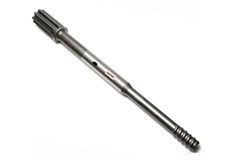
Choosing the right drill rod thread size—T38, T45, or T51—is a decision that directly affects your drilling efficiency, tool life, and cost per meter. Pick the wrong thread, and you'll face poor energy transfer, premature rod failure, and unnecessarily high operating costs.
This guide breaks down the differences between T38, T45, and T51 drill rods, helping you make an informed choice based on your specific rock conditions, hole diameter requirements, and drilling depth.
T-series threads (also known as HM threads) are trapezoidal thread forms widely used in top hammer drilling systems. The "T" stands for trapezoidal, and the number (38, 45, 51) indicates the nominal thread diameter in millimeters—T38 threads are approximately 38 mm in diameter, T45 threads are 45 mm, and T51 threads are 51 mm.
These are the thread sizes of the drill steel—not the diameter of the drill rod body. As thread size increases, so does the rod's torque capacity, impact energy tolerance, and recommended hole diameter range.
The T-series is part of a broader family that includes T35, T38, T45, T51, and T60, and is designed primarily for bench drilling and production drilling applications.
| Specification | T38 | T45 | T51 |
| Nominal thread diameter (approx.) | 38 mm (1.5″) | 45 mm (1.75″) | 51 mm (2″) |
| Typical rod diameters | 32 mm (hex) / 39 mm (round) | 39 mm / 46 mm (round) | 46 mm / 52 mm (round) |
| Thread pitch | .500″ (2 threads per inch) | .610″ | .735″ |
| Recommended hole diameter range | 76–127 mm (3–5″) | 76–127 mm | 89–140 mm (3.5–5.5″) |
| Typical drilling depth | Up to 30 m (mid-shallow) | Up to 40 m | Up to 60 m (deep hole) |
| Best application | General bench, medium-hard rock | Deeper bench, hard rock | Deep long-hole, extreme hard rock |
| Cross-section preference | Hexagonal (fast chip evacuation) | Hexagonal or round | Round (greater bending strength) |
The thread diameter directly determines how much torque the drill string can transmit before binding or failing. T51 threads have the largest diameter among the three, which translates to superior torque capacity and the ability to drive larger-diameter bits. Larger thread size means higher torque capacity and a larger hole range.
T38 threads: Nominal diameter 38 mm (1.5”), with rod diameters commonly available in 32 mm hexagonal and 39 mm round. Thread pitch measures .610″. Available in lengths from 600 mm to 6,100 mm.
T45 threads: Nominal diameter 45 mm (1.75”), with rod diameters typically 39 mm round (with 32 mm hex and 46 mm round also available).
T51 threads: Nominal diameter 51 mm (2”), with rod diameters typically 46 mm to 52 mm round—rod size for T51 is round 51 mm. Standard lengths range from 915 mm (3 ft) to 6,100 mm (20 ft), with many manufacturers offering custom lengths.
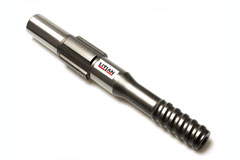
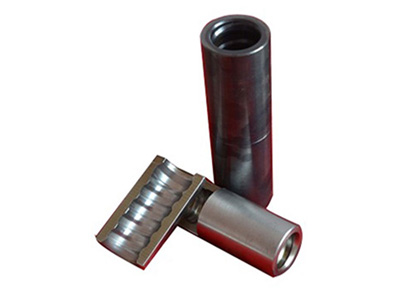
All three thread types are available in two primary rod configurations: MF rods (Male/Female, also called speed rods or quick-connect rods) have one male and one female end for fast connection; and MM rods (Male/Male, also called extension rods) have male threads on both ends and require a separate coupling sleeve to connect.
Torque demand increases significantly as thread size increases. If you're stepping up to T51 rods in harder material, you need to verify that your rig's rotation motor can sustain the torque demand across the drill string—particularly for longer strings exceeding 15 meters. Some mid-duty drilling units simply cannot meet the torque requirement for a T51 string, and this is a selection-stage check you need to make in advance, not a discovery you make on site.
For reference, a hydraulic rock drifter operating T38 or T45 rods typically delivers 18–20 kW of impact power with around 700–1000 Nm of rotation torque. Larger T51 strings require proportionally greater rotation torque and are best paired with heavy-duty hydraulic drifters.
T38, T45, and T51 drill rods are available in both hexagonal and round cross-sections, and the choice between them has practical implications:
Hexagonal rods (H32 for T38, H35 for T38, H38 for T45) : Hexagonal cross-section provides faster chip removal (better flushing) and is preferred for medium-shallow holes of less than 25 meters. The six-flat design also helps with manual handling and provides a better grip for wrenching.
Round rods (R51 for T51, R58 for ST58): Round cross-section offers greater bending strength—critical for deep holes exceeding 25 meters and for drilling through hard rock with high deviation risk. Round rods are also generally less expensive than hexagonal rods of equivalent dimensions.
The hole diameter that each thread size can effectively drive is a primary selection criterion:
T38: Suitable for hole diameters of approximately 76–127 mm. Commonly paired with bit diameters such as 89 mm and 102 mm. T38 is widely used in medium-diameter bench drilling and underground production drilling.
T45: Also suitable for 76–127 mm holes, though with greater torque capacity for the upper end of that range. T45 can drive bit diameters including 89 mm and 102 mm, just like T38. The key difference between T38 and T45 at the same hole diameter is the safety margin and fatigue resistance—T45 provides additional thread strength for more demanding conditions.
T51: Suitable for hole diameters of approximately 89–140 mm. Common bit diameters include 89 mm, 102 mm, 115 mm, and 127 mm. For holes approaching 127 mm and above, T51 is strongly recommended over T45.
One important note on cross-threading: If you intend to operate at the maximum hole diameter of a smaller thread size (for example, a 102 mm or 115 mm bit on T38), the stress on the threads increases substantially. A jump to the next thread size may be justified even if the hole diameter remains the same, because the larger thread provides a greater margin against thread fatigue and breakage.
Drilling depth is another key differentiator:
T38 (Hexagonal rods) : Best suited for medium-shallow holes under 25 meters.
T38/T45/T51 combined strings: In underground mining applications, 37 to 54 meters of drilling depth is achievable with properly matched T38, T45, and T51 MF rods and drill bits.
T51 (Round rods with proper drilling parameters) : Capable of drilling holes up to 60 meters or more in stable ground conditions, using correctly assembled tube strings.
As hole depth increases, so does the torque demand on the drill string. Longer strings experience higher torsional resistance, making T51 the preferred choice for deep-hole applications where hole straightness and energy transmission are critical.
You’re drilling holes in the 76–102 mm range
Your drilling depth is less than 25 meters
You’re working in medium-hard to hard rock (not extremely abrasive)
Fast chip evacuation is a priority—hexagonal T38 rods offer excellent flushing
Your rig’s rotation motor is moderate in torque capacity
Budget and weight are considerations—T38 components are lighter and less expensive
T38 is the workhorse of bench drilling and underground production drilling. It's available from leading manufacturers like Epiroc as T speedrods, ideal for bench and production drilling as extension or drifting drill rods. T38 rods are widely used in mining, quarrying, tunneling, and blasting operations.
You’re drilling holes in the 89–127 mm range, especially toward the larger end
Your drilling depth is in the 25–40 meter range
You’re working in hard, competent rock
You need a balance between torque capacity and cost
Your rig can supply moderate to high rotation torque
You plan to work in harder rock conditions where T38 would be at its limit but T51 would be overkill
T45 drill rods are threaded drilling tools widely used in top hammer rock drilling applications such as mining, quarrying, tunneling, bench drilling, and construction projects. For many hard rock applications, T45 offers the “sweet spot” between the lighter T38 and the heavier T51.
You’re drilling holes of 115 mm diameter and above (up to 140 mm)
Your drilling depth exceeds 30–40 meters (up to 60 meters or more)
You’re drilling in extremely hard, abrasive rock formations (UCS 150+ MPa or f=8~18)
Hole straightness is critical—round T51 rods offer superior bending strength
Your drill rig has a heavy-duty rotation motor capable of sustained torque
Minimizing tool fatigue and maximizing thread life are priorities
T51 rods are designed for underground production and long-hole drilling. They deliver superior torque capacity and are capable of handling the largest hole diameters. If your project involves long-hole drilling, large-diameter blast holes, or extremely hard rock conditions, T51 is the tool of choice. Bench drilling applications with T51 in underground or surface mining often benefit from the rod's exceptional durability in hard material.
Different hydraulic rock drill models are designed to work optimally with specific thread sizes. Common pairings include:
T38: Often paired with 14–18 kW class drifters
T45: Often paired with 18–22 kW class drifters
T51: Typically paired with 20–25 kW class heavy-duty drifters
Operating a thread size that is too large for your drifter may result in inadequate torque to rotate the string efficiently. Conversely, operating a thread size that is too small for your drifter may cause the threads to fatigue and fail prematurely under excessive torque.
Regardless of thread size, the quality of the drill rod's material and heat treatment significantly impacts service life. High-quality T38, T45, and T51 rods are typically manufactured from high-strength alloy steel and undergo full carburization or surface hardening processes. For extension rods, fully carburized or surface-hardened options are available that extend rod life in abrasive conditions.
Proper heat treatment ensures the rod has the right balance of hardness (for wear resistance) and toughness (to resist impact breakage). Rods of the same thread size can vary dramatically in lifespan based solely on the quality of steel and manufacturing precision.
Your choice of drill rod thread must also align with your drill bit thread. A T38 rod requires T38-threaded bits; T45 rods require T45-threaded bits; and T51 rods require T51-threaded bits. While crossover couplings exist to connect different thread types, they introduce additional connection points that reduce energy efficiency and should be used only as temporary solutions.
Oversizing the thread unnecessarily: A T51 rod on a rig with insufficient rotation torque will perform poorly. The drill string may bind, penetration rates will drop, and the drifter will work harder than intended.
Undersizing the thread for the hole diameter: Running a large-diameter bit (e.g., 127 mm) on a T38 thread creates excessive torque demand and accelerates thread wear and fatigue. The additional torsional stress on the smaller cross-sectional area of T38 threads significantly shortens rod life.
Ignoring the rod cross-section: Using a round T38 rod in a shallow application where hexagonal flushing would be beneficial, or using a hexagonal rod in a deep hole where round rod bending strength is needed—both are mismatches that cost efficiency.
Mixing threads without crossover couplings: Attempting to directly connect a T45 rod to a T51 shank adapter without the proper crossover coupling will damage threads on both components.
Whatever thread size you choose, proper maintenance extends rod life:
Keep threads clean and free of debris before each connection
Apply appropriate thread lubricant to prevent galling
Torque connections to manufacturer specifications
Inspect threads regularly for signs of wear or damage
Replace rods with visibly worn or cracked threads
Store rods properly to prevent thread damage during transport
T38, T45, and T51 drill rods each serve distinct roles in top hammer drilling. T38 is your versatile workhorse for moderate depths and medium-diameter holes. T45 provides a robust step up for harder rock and deeper applications. T51 delivers maximum torque capacity for the most demanding deep-hole and large-diameter jobs.
The best choice balances your hole diameter requirements, drilling depth, rock conditions, and drifter capabilities. When in doubt, consult your drill rig manufacturer's specifications and match your thread size to the most demanding condition you expect to encounter—because the right thread choice today determines the cost per meter you drill tomorrow.
Litian Heavy Industry offers a full range of T38, T45, and T51 drill rods, manufactured from high-strength alloy steel with precision-threaded connections. Whether you're drilling in medium-hard limestone or extremely abrasive granite, we have the right thread size and rod configuration for your application. Contact us for expert selection assistance or browse our drill rod product line to find the perfect fit for your project.
This is the first one.

Litian is a professional manufacturer focused on the production of rock drilling tools and excavation tools.
Learn More >