English
 中文
中文 Español
 русский
 français
 português
 العربية
 Deutsch
 italiano
 한국어
한국어 Polska
×
When selecting drill rods for a rock drilling operation, one of the most fundamental decisions is the connection type. Should you choose a tapered drill rod with its friction-based cone connection, or a threaded drill rod with its standardized screw threads?
The answer depends entirely on your application—hole depth, rock conditions, equipment type, and budget all play a role. This article compares tapered and threaded drill rods across key factors to help you make the right choice.
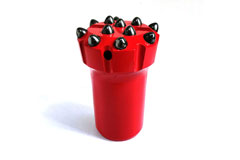
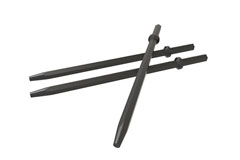
Tapered drill rods (also called taper rods, tapered drill steels, or finished drill rods) feature a hexagonal hollow shaft with a tapered head that connects to the drill bit via a friction fit. The connection relies on a taper angle—typically 4°46′, 6°, 7°, 11°, or 12°—that wedges the bit onto the rod. No threads are involved; the bit is simply tapped onto the tapered end to achieve a firm connection.
Tapered rods are driven by hand-held or air-leg pneumatic rock drills (such as Y18, Y20, Y24, Y26, YT24, and YT28) for shallow hole drilling operations. Common specifications include H22 and H25 hexagonal hollow drill steel, with product lengths typically ranging from 400 mm to 5,000 mm.
Light-duty rock drills typically use 6° or 7° taper angles, while heavy-duty modern hydraulic drill rigs use 11° or 12° taper angles.
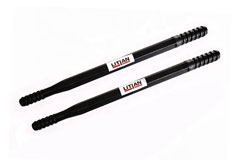
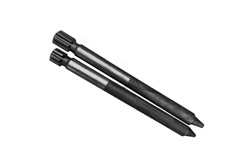
Threaded drill rods (also called extension rods, MF rods, or speed rods) connect via standardized screw threads on both ends. The threads—available in types such as R22, R25, R28, R32, R38, T38, T45, and T51—allow rods to be connected end-to-end using coupling sleeves, creating a continuous drill string.
Threaded rods are used with hydraulic top hammer drill rigs and drilling jumbos for deep hole drilling applications in underground mining, tunneling, and production drilling. Common lengths range from 800 mm to 6,400 mm or more.
Threaded rods come in two primary configurations:
Extension rods (MM rods): Male threads on both ends; require coupling sleeves to connect
MF rods (speed rods): Male thread on one end, female on the other; connect directly without sleeves
| Factor | Tapered Drill Rod | Threaded Drill Rod |
| Connection type | Friction fit via taper angle | Standardized screw threads |
| Typical hole depth | Shallow (<5 m) | Deep (5–30 m+) |
| Equipment | Hand-held/air-leg pneumatic drills | Hydraulic top hammer rigs/jumbos |
| Cross-section | Hexagonal only | Hexagonal or round |
| Common thread/taper | 6°, 7°, 11°, 12° | R25, R32, T38, T45, T51 |
| Rod connection | Bit tapped onto tapered end | Coupling sleeve or direct MF connection |
| Typical applications | Quarrying, small-scale mining, construction | Underground mining, tunneling, production drilling |
| Relative cost | Lower | Higher |
1. Simple, low-cost connection. Tapered connections require no threads, making them simpler and less expensive to manufacture. They are ideal for operations where budget is a primary concern.
2. Quick bit changes. The taper fit allows for fast bit changes without special tools—simply tap the bit onto the tapered end.
3. Lightweight and maneuverable. Tapered rods are typically lighter than threaded rods, making them easier to handle in confined spaces or for hand-held drilling.
4. Suitable for shallow holes. For applications requiring holes of 1–5 meters, tapered rods are often the most practical and cost-effective choice.
5. Proven in small-scale operations. Tapered rods have a long track record in quarrying, dimensional stone extraction, and small-scale mining.
1. Limited depth capability. Tapered connections are not designed for deep holes; as hole depth increases, the friction fit becomes less reliable.
2. Connection slippage. The tapered connection sleeve can loosen or fall off during work, requiring time to repair. The connection is also easily damaged.
3. Energy loss. Tapered rods can suffer from energy dissipation at the joints under high impact, reducing drilling efficiency.
4. Less versatile. Tapered rods cannot be easily extended with additional rods in the same way threaded systems can.
1. Deep hole capability. Threaded rods can be connected end-to-end to reach depths of 30 meters or more, making them essential for production drilling.
2. Secure, standardized connections. Threaded connections provide a reliable, repeatable joint that maintains integrity under high impact and torque.
3. Easy extension. Additional rods can be added simply by screwing on another rod or coupling sleeve.
4. Versatile cross-sections. Threaded rods are available in both hexagonal (more rigid, better energy transfer) and round (lighter, better for deep holes) cross-sections.
5. Compatible with modern rigs. Threaded rods are designed for use with hydraulic top hammer drill rigs, which are standard in modern mining and tunneling operations.
6. MF rods eliminate coupling sleeves. MF (male-female) rods can be connected directly to each other, simplifying the drill string and improving efficiency.
1. Higher cost. Threaded rods are more expensive to manufacture due to the precision threading required.
2. Thread failure risk. If a threaded connection fails, the bit can be lost downhole. Threads are also susceptible to galling and wear.
3. Requires proper maintenance. Threads must be cleaned, lubricated, and inspected regularly to prevent premature failure.
4. More complex connections. Coupling sleeves add complexity and additional potential failure points (though MF rods address this).
5. Heavy and less maneuverable. Threaded rods are generally heavier than tapered rods, making them less suitable for hand-held operations.
Using hand-held or air-leg pneumatic rock drills
Working in quarries, dimensional stone extraction, or small-scale mining
Budget is a primary concern
Quick bit changes and maneuverability are important
Hole depths do not require multiple rod connections
Working in underground mining, tunneling, or production drilling
Need to extend the drill string with multiple rods
Require secure, reliable connections under high impact
Need the versatility of hexagonal or round cross-sections
The choice between tapered and threaded drill rods ultimately comes down to one question: how deep do you need to go?
Tapered rods are the workhorse of shallow drilling—simple, affordable, and effective for hand-held operations in quarries and small-scale mining. Their friction-fit connections are quick and easy, but they simply cannot match the depth capability of threaded systems.
Threaded rods, on the other hand, are built for production drilling. They provide secure, standardized connections that can be extended to virtually any depth, making them essential for underground mining, tunneling, and large-scale construction projects.
Neither is inherently "better"—each serves a specific purpose. The right choice depends entirely on your equipment, your hole depth requirements, and your operating conditions.
Need help selecting the right drill rod for your application? Browse our drill rod product line or contact us for expert guidance.
Q1: Can I use a tapered drill rod with a threaded drill bit?
No. Tapered rods require tapered bits that match the specific taper angle (e.g., 7°, 11°, 12°). Threaded rods require bits with matching threads (e.g., R32, T38, T45). The connection methods are fundamentally different and not interchangeable.
Q2: Which type of drill rod is better for deep hole drilling?
Threaded drill rods are better for deep hole drilling. They can be connected end-to-end using coupling sleeves or MF connections to reach depths of 30 meters or more. Tapered rods are limited to shallow holes typically under 5 meters.
Read more: What Is Drill Rod and Drill Rod Sizes?
Q3: Why are tapered drill rods still used if threaded rods are more versatile?
Tapered rods remain widely used because they are simpler, less expensive, and lighter. For shallow holes in quarrying and small-scale mining, the lower cost and ease of handling make tapered rods the practical choice. They are also the standard for hand-held pneumatic rock drills.
Read more: Taper Drill Rods in Efficient Rock Drilling Operations
Q4: What are the common taper angles for tapered drill rods?
Common taper angles include 4°46′, 6°, 7°, 11°, and 12°. Light-duty rock drills typically use 6° or 7° taper angles, while heavy-duty modern hydraulic drill rigs use 11° or 12°.
Q5: What are MF rods and how do they differ from standard extension rods?
MF rods (male-female rods) have a male thread on one end and a female thread on the other, allowing them to connect directly without coupling sleeves. Standard extension rods have male threads on both ends and require a separate coupling sleeve to connect. MF rods are faster to connect and disconnect, making them popular in production drilling.
Read more: Comprehensive Guide to Top Hammer Drilling Tools: Extension Rods, Drifter Rods, and MF Rods
"Taper Drill Rods – Application Guide" – Stone Demolition (industry publication). https://www.stonedemolition.com/news/taper-drill-rods-application-guide
"Rock Drilling Rods: Classification and Application Guide" – Stone Demolition (industry publication). https://www.stonedemolition.com/news/rock-drilling-rods-classification-and-application-guide
"What material are rock drill rods made of? Are the dimensions and weights the same?" – Stone Demolition (industry publication). https://www.stonedemolition.com/news/what-material-are-rock-drill-rods-made-of-are-the-dimensions-and-weights-the-same
"A review of drill rod connection methods in percussive rock drilling" – ScienceDirect (academic journal). https://www.sciencedirect.com
"Failure analyses and wear mechanisms of rock drill rods, a case study" – Elsevier, Engineering Failure Analysis, 2019. https://www.sciencedirect.com/science/article/abs/pii/S1350630718314420
"Influence of thread geometry on fatigue life of drill rod connections" – Springer (International Journal of Fatigue). https://link.springer.com
"Stress wave propagation in percussive drilling: effect of rod geometry" – Taylor & Francis (Geomechanics and Geoengineering). https://www.taylorfrancis.com
"Comparative study of energy transmission efficiency in tapered and threaded drill rod systems" – OnePetro (SPE technical paper). https://onepetro.org
"Rock drilling tools: selection criteria for quarry operations" – Pit & Quarry (industry publication). https://stage.pitandquarry.com
"Optimization of drill rod selection for underground production drilling" – ResearchGate (industry study). https://www.researchgate.net
This is the first one.

Litian is a professional manufacturer focused on the production of rock drilling tools and excavation tools.
Learn More >