English
 中文
中文 Español
 русский
 français
 português
 العربية
 Deutsch
 italiano
 한국어
한국어 Polska
×
If you work in drilling, mining, or construction, you have likely encountered the T38 drill bit. It is one of the most widely used threaded button bits in top hammer drilling, known for its versatility, durability, and efficient rock penetration.
This article explains what a T38 drill bit is, how it works, its key specifications, and where it is commonly used.
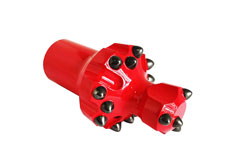
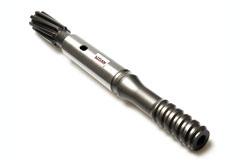
A T38 drill bit is a threaded button bit used in top hammer drilling systems. The name "T38 " comes from its thread type: the "T" stands for trapezoidal thread, and "38" refers to the nominal thread diameter of approximately 38 mm (1.5 inches). This threaded connection allows the bit to securely attach to a T38 drill rod or shank adapter, forming a reliable drill string.
T38 drill bits are typically manufactured from high-quality alloy steel with tungsten carbide buttons pressed or brazed into the bit face. The tungsten carbide inserts provide exceptional wear resistance, enabling the bit to maintain its cutting efficiency even in hard and abrasive rock formations.
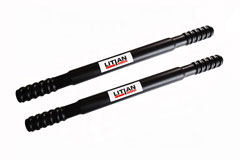
The T38 thread system is engineered for toughness. Epiroc describes the T-drill string thread system as “robust enough to prevent product breakage in the blast hole,” which reduces the need for frequent rod and shank changes. The trapezoidal thread design provides a secure, high-strength connection that transmits impact energy efficiently from the drill rig to the rock face.
T38 drill bits operate using a combination of rotary and percussive forces—the fundamental principle of top hammer drilling.
Impact energy transmission: The piston inside the hydraulic rock drill strikes the shank adapter, generating a compressive stress wave that travels down the drill rod to the T38 bit.
Rock fracturing: The tungsten carbide buttons on the bit face concentrate this impact energy onto the rock surface. Each blow fractures the rock through a combination of crushing and chipping.
Rotation: Simultaneously, the drill rig rotates the drill string. This rotation ensures that the bit’s buttons contact fresh rock with each impact, creating a continuous borehole.
Cuttings removal: Flushing air or water flows through flushing holes in the bit, carrying rock cuttings up the annulus to the surface.
T38 drill bits are available with different button shapes and face designs to match specific rock conditions:
| Button Shape | Best Application |
| Spherical (domed) | Hard, abrasive rock (granite, quartzite); maximum wear resistance |
| Ballistic | Medium-hard rock; faster penetration |
| Parabolic | Soft to medium rock; balanced performance |
| Face Design | Best Application |
| Drop center | Improved hole straightness; better flushing |
| Flat face | Extreme hardness; resists body wear |
| Convex | Concentrates impact energy |
Retrac (retractable) button bits feature a reinforced skirt design that prevents jamming in fractured rock, making them particularly useful in challenging ground conditions.
| Specification | Details |
| Thread type | T38 (trapezoidal, ~38 mm / 1.5″ nominal diameter) |
| Bit diameter range | 64 mm to 127 mm (2.5″ to 5″) |
| Common diameters | 64 mm, 76 mm, 89 mm, 102 mm, 115 mm, 127 mm |
| Button materials | Tungsten carbide (grades such as YK05, T6) |
| Body material | High-quality alloy steel, heat-treated |
| Flushing holes | Typically M.5 mm diameter |
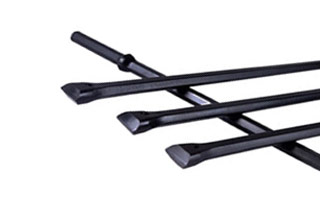
| Rod cross-sections | Hexagonal (H32) or round (Rnd38) |
| Rod lengths | 1,830 mm to 6,095 mm (6′ to 20′) |
T38 drill bits are used across a wide range of drilling applications:
Bench drilling: Surface mining and quarry bench drilling
Production drilling: Underground production drilling in mines
Tunneling: Tunnel face drilling and rock support
Construction: Foundation drilling and rock anchoring
Long-hole drilling: Deep hole drilling with extension rods
Typical hole diameters for T38 drilling range from 64 mm to 127 mm, making T38 a versatile choice for medium-diameter blast holes and production drilling.
While both T38 and T45 are common thread types in top hammer drilling, they serve different purposes. The key difference between T38 and T45 is the safety margin and fatigue resistance—T45 provides additional thread strength for more demanding conditions.
| Factor | T38 | T45 |
| Thread diameter | ~38 mm | ~45 mm |
| Hole diameter range | 64–127 mm | 66–152 mm |
| Torque capacity | Moderate | Higher |
| Best application | Bench drilling, production drilling | Heavy-duty production, deep holes |
For most bench drilling and production drilling applications, T38 offers an excellent balance of performance and cost. For deeper holes or more demanding rock conditions, T45 provides additional thread strength and fatigue resistance.
The T38 drill bit is a cornerstone of modern top hammer drilling. Its robust trapezoidal thread design, combined with high-quality tungsten carbide buttons, delivers reliable performance across a wide range of rock conditions and applications.
Whether you are drilling blast holes in a granite quarry, production holes in an underground mine, or anchor holes in a construction project, the T38 drill bit offers the versatility, durability, and efficiency that drilling professionals rely on.
Choosing the right bit—with the correct thread type, diameter, button shape, and face design for your specific rock conditions—is essential for maximizing penetration rates, extending tool life, and controlling drilling costs. For most medium-diameter bench and production drilling applications, T38 is the proven, reliable choice.
Q1: What does "T38" stand for in a drill bit?
"T" stands for trapezoidal thread, and "38" refers to the nominal thread diameter of approximately 38 mm (1.5 inches). This standardized thread design ensures secure attachment to T38 drill rods and shank adapters.
Q2: What hole diameters can a T38 drill bit handle?
T38 drill bits are available in diameters ranging from 64 mm to 127 mm (2.5″ to 5″). Common sizes include 64 mm, 76 mm, 89 mm, 102 mm, 115 mm, and 127 mm.
Read more: T38 vs T45 vs T51 Drill Rod: How to Choose the Right Thread for Your Rock Drilling Application
Q3: What is the difference between spherical and ballistic button bits?
Spherical (domed) buttons are designed for hard, abrasive rock and offer maximum wear resistance. Ballistic buttons provide faster penetration in medium-hard rock but have shorter wear life. The choice depends on your specific rock conditions and drilling priorities.
Read more: Button Bit Wear Patterns and What They Mean
Q4: What is a retrac button bit and when should I use it?
A retrac (retractable) button bit has a reinforced skirt design that helps prevent the bit from jamming when pulled back through fractured or broken rock. It is recommended for drilling in challenging ground conditions where standard bits may become stuck.
Q5: What is the typical application for T38 drill bits?
T38 drill bits are widely used in bench drilling, production drilling, tunneling, and construction. Typical applications include blast hole drilling in quarries, production drilling in underground mines, and rock anchoring in construction projects.
Epiroc T-drill strings product page – Epiroc. https://www.epiroc.com/en-et/products/rock-drilling-tools/tophammer/epiroc-t-drill-strings
Epiroc Tophammer catalog (T38 technical data) – Epiroc. https://www.epiroc.com/content/dam/epiroc/rock-drilling-tools/documents/Tophammer%20catalog.pdf
T38 64mm-89mm Retract Thread Button Drill Bit for Mining and Rock Drilling – Made-in-China.com. https://www.madeinchina.com/mall/show-T38-64mm-89mm-Retract-Thread-Button-Drill-Bit-for-Mining-and-Rock-Drilling_1253411.html
T38 76mm Spherical Button Drill Bit – GMD Equipment. https://www.gmd-eqpt.com

Litian is a professional manufacturer focused on the production of rock drilling tools and excavation tools.
Learn More >