English
 中文
中文 Español
 русский
 français
 português
 العربية
 Deutsch
 italiano
 한국어
한국어 Polska
×
Rock drill rods are the backbone of any hammer drilling operation. They connect the power source—whether hydraulic or pneumatic—to the drill bit, transmitting the impact energy and rotational torque that actually breaks the rock. Without a properly selected and maintained drill rod, even the most powerful rock drill will struggle to achieve acceptable penetration rates.
In percussive drilling, force and energy for rock fragmentation are generated by repeated collisions between a piston and a shank rod, and then transmitted to the drill bit through extension rods in the form of stress waves. Understanding what drill rods are, how they work, and how to choose the right type for your application is essential for anyone involved in mining, construction, or quarrying operations.
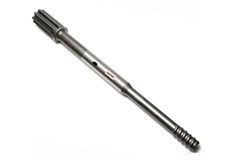
Rock drill rods are high-strength steel components that serve as the connecting link between the rock drill and the drill bit. Their primary function is to transmit the impact force and torque generated by the rock drill to the drill bit, enabling the bit to penetrate and fragment rock to create boreholes.
Drill rods are typically manufactured from high-strength alloy steel and undergo specialized heat treatments to withstand repeated impact loads, torsional stresses, bending forces, and abrasive operating conditions. They are used across a wide range of applications, including mining, quarrying, tunneling, construction, geotechnical anchoring, and slope stabilization projects.
The key characteristics of a quality drill rod include:
High fatigue strength to withstand millions of impact cycles
Adequate torsional strength to transmit rotation without twisting
Wear resistance to survive abrasive rock cuttings
Precision threads for secure, energy-efficient connections
In a rock drill, the piston is reciprocated by hydraulic or pneumatic pressure and collides with the shank rod thousands of times per minute. Each collision generates a compressive stress wave that travels down the drill rod at the speed of sound in steel—approximately 5,000 meters per second.
This stress wave carries the impact energy from the piston to the drill bit, where it is converted into rock fracture. The geometry of the drill rod, including its diameter, cross-section shape, and thread design, all influence how efficiently this stress wave is transmitted. Proper rod selection ensures that maximum energy reaches the rock face rather than being dissipated as heat or vibration within the drill string.
Drill rods can be classified in several ways. The most common classification is by connection method:
Tapered drill rods feature a hexagonal hollow shaft with a shank structure at one end that connects to the drilling equipment. The head of the rod is tapered—typically at angles of 6°, 7°, 11°, or 12°—to connect with tapered bits.
These rods are primarily used with small pneumatic rock drills or hydraulic rock drills for shallow hole drilling operations. They are commonly employed in quarrying, coal mining, and construction for blast holes and other drilling works. Tapered drill rods are driven by hand-held or air-leg rock drills and are ideal for applications where maneuverability and quick bit changes are important.
Key characteristics:
Suitable for shallow holes (typically less than 5 meters)
Connected via friction fit using a taper angle
Hexagonal cross-section for efficient energy transfer
Lightweight and easy to handle
Extension rods are threaded drill rods designed for deeper drilling applications. They have male threads on both ends (MM rods) or one male and one female end (MF rods, also called speed rods). Extension rods are more suitable for drilling deep holes compared to tapered rods.
These rods are used in bench drilling, underground long-hole drilling, and tunneling applications. Extension rods typically have a round cross-section, which provides greater bending strength for deep holes, though hexagonal versions are also available for shallower applications.
Key characteristics:
Suitable for deep holes (up to 30 meters or more)
Connected via threaded joints
Available in round or hexagonal cross-sections
Require coupling sleeves for MM rod connections
MF rods are a subtype of extension rods with one male and one female end. This design eliminates the need for separate coupling sleeves, as each rod screws directly into the next. MF rods are widely used in production drilling where fast rod changes are essential.
Integral drill rods are one-piece tools with the drill bit forged directly onto the rod. They are typically used in granite and marble quarries and underground mining for small blasting holes. Integral rods offer the advantage of a single, continuous piece with no threaded connections to fail, but they are less flexible than modular systems.
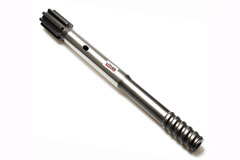
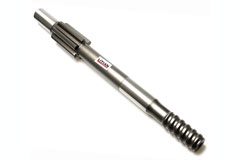
Shank rods are short, robust rods that connect directly to the rock drill chuck. They absorb the initial impact from the piston and stabilize the drill string. Shank rods are typically the first rod in the drill string and are subject to the highest stress concentrations.
Drill rod lengths vary widely depending on the application and drilling depth requirements. Standard lengths range from 400 mm to 8,000 mm, with common increments including 0.5 m, 1 m, 1.5 m, 3 m, 4 m, and 6 m. Custom lengths can be manufactured for specific project requirements.
Drill rod diameters typically range from 19 mm to 64 mm, with common sizes including 19 mm, 22 mm, 25 mm, 32 mm, 38 mm, and 46 mm. The diameter is determined by the type of drill bit being used, the hole diameter required, and the depth of the hole. Larger diameter rods offer greater bending strength and torque capacity but are heavier and more expensive.
Drill rods are available in two primary cross-section shapes:
| Cross-Section | Characteristics | Best Application |
| Hexagonal | More rigid, heavier, transfer energy more efficiently, provide better flushing | Shallow to medium-depth holes; manual handling |
| Round | Lighter than hex rods; normally used in extension drilling applications | Deep holes; mechanized drilling; greater bending strength |
For threaded rods, common thread types include R22, R25, R32, R38, T38, T45, and T51. The thread type determines the rod's torque capacity, compatibility with other components, and the hole diameter range it can support.
Choosing the correct drill rod for your application requires consideration of several factors:
| Factor | Consideration |
| Hole depth | Shallow holes (<5m): tapered or integral rods; Deep holes (>5m): extension or MF rods |
| Rock hardness | Hard rock requires higher-strength rods with appropriate heat treatment |
| Drill rig type | Hand-held drills typically use tapered rods; jumbos and production drills use threaded rods |
| Hole diameter | Determines rod diameter and thread type requirements |
| Mobility requirements | Tapered rods are easier to handle and change in confined spaces |
A good starting point: For shallow blast holes in quarries using hand-held rock drills, tapered drill rods with 7° or 11° taper are typically the most cost-effective choice. For production drilling in underground mines with depths exceeding 10 meters, extension rods or MF rods with T38 or T45 threads are generally preferred.
Proper maintenance is essential for maximizing drill rod life and preventing costly failures. Key maintenance practices include:
Inspect drill rods daily for signs of wear, damage, or corrosion. Focus on:
Thread condition: Look for wear, galling, or deformation
Surface condition: Check for scratches, cracks, or mushrooming
Straightness: Bent rods should be removed from service immediately
Thread maintenance is essential for maximizing drill rod life. Clean threads thoroughly before every connection to remove dirt, debris, and old thread compound. Apply a quality thread compound with at least 50% zinc content to every joint, every time.
Store drill rods in a dry, covered area off the ground. Clean rods thoroughly before storage, apply anti-rust lubricant to threaded parts, and cover with protective caps. Avoid prolonged exposure to damp or corrosive environments.
Replace drill rods when you observe:
Visible thread damage or excessive wear
Mushroomed pin ends
Bent or twisted sections
"Hourglassing" effect on the rod body
Leaking connections that won't seal
Rock drill rods may seem like simple components, but they are sophisticated engineering products designed to transmit enormous forces under extreme conditions. From the stress wave generated by each piston impact to the torque required to rotate the bit, every aspect of the rod's design affects drilling performance.
The key takeaways are straightforward:
Match the rod to the application—tapered for shallow holes, threaded for deep holes
Choose the right cross-section—hexagonal for energy efficiency, round for bending strength
Maintain threads meticulously—clean them, lubricate them, and inspect them daily
Replace before failure—a rod retired early is cheaper than one that breaks downhole
With proper selection and maintenance, drill rods will deliver reliable performance, reduce downtime, and lower your overall drilling costs.
Q1: What is the difference between a tapered drill rod and an extension rod?
Tapered drill rods connect to the bit via a friction-based taper fit (typically 6°, 7°, 11°, or 12°) and are used for shallow holes with hand-held or air-leg drills. Extension rods use threaded connections and are designed for deeper holes in mechanized drilling applications.
Read more: Taper Drill Rods in Efficient Rock Drilling Operations
Q2: How do I choose between hexagonal and round drill rods?
Hexagonal rods are more rigid, heavier, and transfer energy more efficiently, making them ideal for shallow to medium-depth holes where manual handling is involved. Round rods are lighter and provide greater bending strength, making them the preferred choice for deep extension drilling applications.
Read more: What Is Drill Rod and Drill Rod Sizes?
Q3: What causes drill rod threads to fail?
Thread failure is most commonly caused by galling—adhesive wear between mating steel surfaces—which occurs when threads are not properly cleaned or lubricated, when the wrong thread compound is used, or when excessive torque is applied. Fatigue cracking from repeated impact cycles is another common failure mode.
Q4: How often should drill rod threads be inspected?
Drill rod threads should be inspected daily before use. Look for visible wear, galling, deformation, or contamination. Use a thread gauge for more precise assessment. Any rod showing signs of significant thread wear should be removed from service immediately.
Q5: What is the typical lifespan of a rock drill rod?
Drill rod lifespan varies significantly based on rock hardness, drilling depth, maintenance practices, and operating parameters. With proper selection, regular inspection, and correct maintenance—including daily thread cleaning and lubrication—rods can last for thousands of meters of drilling. However, rods used in highly abrasive rock or operated with incorrect parameters will wear much faster.
Read more: How long do drill bit extension rods typically last, and what factors affect their lifespan?
Stress Wave Propagation in Rods during Percussive Drilling – Liang, Y.Z., Hashiba, K., Fukui, K., Koizumi, M. ISRM International Symposium – 8th Asian Rock Mechanics Symposium, Sapporo, Japan, October 2014. https://onepetro.org/ISRMARMS/proceedings-abstract/ARMS814/ARMS814/ISRM-ARMS8-2014-180/41571
Numerical Study on the Effect of Shockwaves Used for Percussive Drilling – Ray, K., Mishra, S. ISRM Regional Symposium – 12th Asian Rock Mechanics Symposium, Hanoi, Vietnam, November 2022. https://onepetro.org/ISRMARMS/proceedings-abstract/ARMS1222/ARMS1222/ISRM-ARMS12-2022-029/515497
Failure analyses and wear mechanisms of rock drill rods, a case study – Elsevier, Engineering Failure Analysis, 2019. https://www.sciencedirect.com/science/article/abs/pii/S1350630718314420
Influence of a waveform on the bit–rock impact response considering reflected waves in a drill rod – ScienceDirect, 2024. https://www.sciencedirect.com
Drill Rod FAQ: Types, Materials, Sizes, Selection & Performance – Kelleg Drill, 2026. https://kellegdrill.com
What Is a Drill Rod? The Complete 2026 Buyer's Guide to Types, Materials, Sizes & Selection – Kelleg Drill, 2026. https://kellegdrill.com
Trenchless Technology – Thread TLC – Trenchless Technology, April 2025, Page 45. https://digital.trenchlesstechnology.com
When do you replace your Drill Rods? – Trenchless Australasia, February 2025. https://www.trenchless-australasia.com

Litian is a professional manufacturer focused on the production of rock drilling tools and excavation tools.
Learn More >