English
 中文
中文 Español
 русский
 français
 português
 العربية
 Deutsch
 italiano
 한국어
한국어 Polska
×
Deep hole drilling is a critical step in tunneling projects, particularly for rock bolting, grouting, drainage, pre-excavation probing, and support installation in NATM (New Austrian Tunneling Method) or drill-and-blast operations. Achieving reliable, straight, and accurate deep holes—often 10–30 meters or more—requires careful planning, the right equipment, and disciplined execution. Poor practices lead to deviation, stuck tools, poor grout penetration, or safety risks, while optimized deep hole drilling improves ground stability, reduces overbreak, and accelerates cycle times.
Before drilling begins, define the exact purpose and specifications for each deep hole.
In tunneling, deep holes serve multiple roles:
Pre-grouting to seal water-bearing fractures ahead of the face
Rock bolt or cable bolt installation for arch or sidewall support
Drainage holes to relieve groundwater pressure
Probing ahead to detect faults, karsts, or changes in rock quality
Typical requirements include:
Depths of 15–40 meters (sometimes up to 50–100 m in special cases)
Diameters of 51–127 mm for bolting/grouting, smaller for probing
Straightness tolerance of <1–2% deviation over length
Clean, stable hole walls for effective grout or bolt anchoring
Site geology—rock strength, jointing, foliation, groundwater presence—directly dictates depth, diameter, and drilling method. Always conduct a detailed geotechnical risk assessment and align hole patterns with the tunnel design.
Selecting the right drilling method and equipment is fundamental to success in deep hole tunneling applications.
Top hammer drilling remains popular for holes up to 20–30 meters in medium-hard rock. It offers high penetration rates and relatively low equipment costs. However, energy loss through the drill string limits its performance in deeper holes.
Down-the-hole (DTH) drilling becomes the preferred choice for depths beyond 30 meters and in harder or more abrasive rock. It provides consistent impact energy, better hole straightness, and the ability to handle larger diameters.
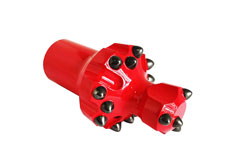
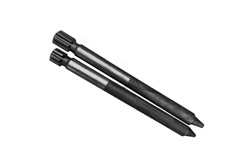
The rig must deliver sufficient torque and feed force for the expected depth and rock strength. Hydraulic top hammer rigs or powerful DTH setups with adequate compressor capacity (typically 20–30 m³/min or more for deep DTH) are necessary. High-strength, straight drill rods—such as MF or DT series—with precision-machined threads minimize deviation and wear over long strings. Bit selection should match the rock: button bits perform well in hard formations, cross bits suit softer ground, and reaming shells can enlarge holes when needed. Stabilizers and centralizers are often used in fractured or anisotropic rock to maintain alignment.
Matching the entire system—rig power, rod quality, bit design, and flushing capacity—to the anticipated geology and hole depth prevents underpowered setups that lead to deviation, slow progress, or stuck tools.
Efficient removal of cuttings is one of the most critical aspects of deep hole drilling. Inadequate cleaning causes blockages, bit balling, stuck strings, and poor hole quality.
Consistent, high-velocity flushing must be maintained throughout the operation. Air flushing works well in dry, stable rock, while water, foam, or mist systems are better suited for wet or fractured ground to improve chip lift and cool the bit. Flush volume should be adjusted according to rock type and depth—higher volumes are needed in deeper holes to overcome gravity and friction losses.
In very deep or unstable ground, dual-wall rods or reverse-circulation techniques can enhance cuttings return and reduce the risk of hole collapse. Operators should continuously monitor return flow; a sudden reduction in cuttings often signals packing off, collaring problems, or formation instability.
At total depth, a dedicated cleaning pass—using a reaming bit, brushing tool, or high-volume flush—is recommended before installing bolts or injecting grout. This ensures the hole remains open, clean, and stable for the next step in the support cycle.
Real-time monitoring and instrumentation significantly improve control, reduce deviation, and enhance safety during deep hole drilling.
Modern tunneling rigs increasingly integrate Measurement While Drilling (MWD) systems that continuously log penetration rate, torque, vibration, thrust, and flush pressure. These parameters provide immediate feedback on rock changes and drilling performance.
Inclinometers and gyroscopic tools mounted in the drill string allow real-time tracking of hole deviation, enabling operators to make corrective adjustments if alignment drifts outside acceptable limits.
Drilling parameter monitoring software installed on the rig can alert crews when torque, feed force, or vibration exceeds safe thresholds, helping prevent rod fatigue or stuck strings.
In some projects, downhole cameras or geophysical logging tools are deployed to visually inspect hole walls or confirm cleanliness and stability before proceeding.
Continuous inclination data helps maintain deviation within 0.5–1% over 30 m, critical for long rock bolts or precise grouting patterns.
Sudden changes in penetration rate or torque often signal faults, water inflows, or weaker zones, allowing the team to stop, probe further, or adjust support measures.
Deep hole drilling in tunnels presents unique risks that must be proactively managed.
Common challenges include:
Hole deviation from geological anisotropy or improper setup
Stuck rods due to swelling clay, blocky ground, or poor flushing
Water inflows causing hole instability or equipment damage
Fatigue failure of rods or threads from excessive vibration
Safety priorities:
Always use certified, inspected rods and bits rated for the expected loads.
Maintain safe stand-off distances and use remote-operated rod handling where possible.
Install blowout preventers or packers for high-pressure water zones.
Train crews on stuck rod recovery procedures (e.g., back-off tools, fishing, jarring).
Conduct regular risk assessments and have emergency response plans for hole collapse or sudden inflows.
By staying alert to early warning signs—such as slower penetration, increased vibration, reduced cuttings return, or visible deviation—and consistently applying these best practices (clear specification, method selection, flushing discipline, real-time monitoring, and proactive safety), tunneling teams can deliver straighter, cleaner, and more reliable deep holes that strengthen ground support and accelerate project progress.
For operators seeking high-performance drilling consumables that help achieve these results even in challenging tunnel conditions, Litian offers a full range of precision-engineered top hammer and DTH rods, bits, and adapters designed for durability, straightness, and long service life.
This is the first one.

Litian is a professional manufacturer focused on the production of rock drilling tools and excavation tools.
Learn More >