English
 中文
中文 Español
 русский
 français
 português
 العربية
 Deutsch
 italiano
 한국어
한국어 Polska
×
In rock drilling operations across mining, quarrying, tunneling, and construction, selecting the right drilling tool can mean the difference between hitting production targets and missing them. Two of the most commonly discussed tools in top hammer drilling are the button bit and the reamer bit (often searched as “reamer drill bit”). While their names sometimes appear together in search results—like “drill bit vs reamer” or “reamer vs drill bit”—these tools serve fundamentally different roles in the drilling process. Understanding when and why to use each is essential for maximizing penetration rates, controlling operational costs, and extending tool life across your fleet.
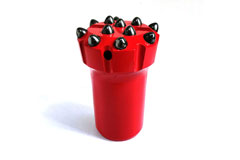
A button bit is a percussive rock drilling tool featuring tungsten carbide inserts (“buttons”) pressed or brazed into a hardened steel bit body. These buttons—arranged in a pattern across the bit face—are the primary working surface, designed to crush rock through high-frequency impact energy delivered by a hydraulic or pneumatic rock drill.
Button bits are the workhorse of production drilling. They create the hole itself by fracturing the rock directly beneath the bit face. Available in diameters ranging from approximately 32 mm to 115 mm for top hammer applications, threaded button bits connect to the drill string via R25, R28, R32, R35, R38, T38, T45, T51, or GT60 thread systems, making them compatible with a wide range of drilling rigs and rod configurations.
The button geometry on the bit face plays a decisive role in performance. Ballistic (bullet-shaped) buttons deliver aggressive, high-speed penetration in abrasive but medium-hard formations; spherical buttons trade some speed for exceptional wear resistance in extremely hard rock like granite; and parabolic buttons offer a balanced profile for general-purpose applications. For a complete guide to selecting the optimal button configuration, see How to Choose the Right Button Bit for Rock Drilling.
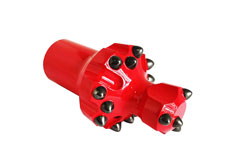
A reamer bit (also known as a reaming bit, reamer drill bit, or reaming drill bit) is a specialized rock drilling tool designed to enlarge an existing pilot hole to a larger diameter. Unlike button bits, reamer bits do not create the initial hole—they follow and expand it, functioning as a hole-opening tool in a two-pass drilling sequence.
Reaming bits are typically used in underground blasting operations where precise hole sizing is critical. After blastholes are drilled in the tunnel face with diameters of 43–51 mm, certain holes in the blast pattern are enlarged to 76–102 mm using a reaming bit. These enlarged holes are then left unloaded—meaning no explosives are placed in them. During detonation, the empty voids enable the surrounding rock formation to implode more effectively, resulting in superior rock fragmentation and more efficient blasting patterns.
Standard reaming bits feature face designs with domed or narrow-nose fronts intended to guide the tool smoothly through the pre-drilled hole while enlarging it. One well-known challenge in reaming operations is bit retrieval—at the end of a hole, loose rock debris often causes the bit to seize when being pulled back. To address this, manufacturers have introduced “retrac”-type reaming bits with rear cutting fins that push rock chips out of the way during extraction.
For operations requiring sequential reaming in challenging rock conditions, Litian offers specialized designs. Browse reaming bit products to find configurations suited to your project.
While both tools are used in top hammer drill strings and share threaded connections, their fundamental purpose could not be more different. The table below summarizes the key distinctions:
| Comparison Aspect | Button Bit | Reamer Bit |
| Primary Function | Creates the initial hole by crushing rock | Enlarges an existing pilot hole to final diameter |
| Role in Drill String | Leading component; makes primary contact with rock | Intermediate component between pilot bit and drill string |
| Typical Diameters (Top Hammer) | 32–115 mm | 64–152 mm (final reamed diameter) |
| Face Design | Ballistic, spherical, or parabolic buttons across the face | Dome or narrow-nose front for guided hole enlargement |
| Drilling Sequence | First pass (or single-pass) | Second pass (follows pilot hole) |
| Thread Compatibility | R25–T51, GT60 | R25–T51, GT60 (must match drill string) |
| Primary Application | Production blast holes, bolting, exploration | Cut holes in tunneling, large-diameter blast holes |
The difference is clear: button bits are hole creators; reamer bits are hole enlargers. They do not compete against each other but instead serve complementary roles in a well-designed drilling program.
Button bits are the go-to choice for high-volume blast hole drilling in mining and quarrying. When the objective is to drill as many meters per shift as possible—whether in a limestone quarry or an underground gold mine—button bits offer the combination of penetration speed and durability that keeps operations profitable. One aggregate quarry recorded 42% faster drilling rates after switching to ballistic button bits, with the net gain in blasted tonnage more than justifying the increased wear rate.
For heavy-duty production environments, threaded button bits from Litian are engineered to handle a broad spectrum of rock formations, from soft limestone to hard and abrasive granite.
Reamer bits come into the picture when the required hole diameter exceeds the capabilities of the rock drill and existing tooling—or when blast design mandates larger-diameter unloaded cut holes to achieve optimal fragmentation. Typical diameter ranges for top hammer reaming operations span from 64 mm up to 152 mm, depending on thread system and rig capacity.
Selecting the right reamer bit size is not simply about choosing the largest diameter available. The process involves balancing several factors:
Desired final borehole diameter (determined by blast design or structural requirements)
Pilot hole size (typically 20–40 mm smaller than the target reamed diameter to maintain hole straightness)
Thread compatibility with existing rods and drifters (R32 for lighter rigs, T45/T51 for heavy-duty applications)
Rock formation characteristics (abrasive rock demands larger peripheral buttons and robust body designs)
Proper sizing is essential: an oversized reamer bit increases torque demands and accelerates equipment wear, while an undersized bit reduces efficiency and may require additional passes to achieve the target diameter.
In well-planned drilling operations, these two tools are not competitors—they are partners. In tunneling, for example, a button bit first drills a full pattern of blast holes to standard diameter. Then, a reamer bit enlarges select cut holes to create the empty voids that define the blast sequence. This combined approach maximizes both drilling speed (from the button bit’s high penetration rate) and blasting effectiveness (from the reamer bit’s precise hole enlargement). Together, they help operators extract more rock using fewer explosives, reducing cost per ton and improving fragmentation quality.
The choice between a button bit and a reamer bit is not a matter of picking one over the other—it is about understanding the distinct role each plays in the drilling workflow. Button bits are the primary rock-cutting tools that create holes; reamer bits are the precision instruments that enlarge them to meet blasting specifications. Choosing the right button geometry (ballistic, spherical, or parabolic), sizing the reamer to match the pilot hole, and ensuring thread compatibility across the entire drill string are the three decisions that most directly influence penetration rate, hole quality, and overall drilling cost. In high-production environments where meters per shift and blast fragmentation quality both matter, a properly coordinated button-and-reamer strategy consistently outperforms either tool deployed in isolation.
This is the first one.

Litian is a professional manufacturer focused on the production of rock drilling tools and excavation tools.
Learn More >