English
 中文
中文 Español
 русский
 français
 português
 العربية
 Deutsch
 italiano
 한국어
한국어 Polska
×
Down-the-hole (DTH) drilling is one of the most efficient and widely used methods for penetrating hard rock formations in mining, construction, water well drilling, and geotechnical projects. Unlike top hammer drilling, where the impact energy is generated at the surface and transmitted through a long drill string, DTH drilling places the hammer directly behind the drill bit—at the bottom of the hole. This fundamental difference gives DTH drilling a distinct advantage in deep-hole applications and hard rock conditions.
DTH drilling is a percussive drilling technique in which a hammer—powered by compressed air or high-pressure fluid—is located at the bottom of the borehole, directly above the drill bit. The hammer delivers rapid, high-frequency impacts directly to the bit, which fractures the rock while the drill string rotates to advance the hole.
The name “down-the-hole” refers to the hammer's position: it travels down the hole with the drill string, rather than remaining at the surface. This configuration minimizes energy loss and ensures that maximum impact force reaches the rock face, regardless of hole depth.
The DTH drilling process follows a continuous cycle of impact, rotation, and cuttings removal:
1. Hammer activation. Compressed air (or high-pressure water) is delivered through hollow drill rods to the hammer at the bottom of the hole. The air or fluid drives a piston inside the hammer, which strikes the drill bit at high frequency.
2. Rock fracturing. The percussive blows from the piston fracture the rock into small chips. The hammer delivers these impacts while the drill string rotates, allowing the bit to advance through the formation.
3. Cuttings removal. The same compressed air or fluid that powers the hammer exits through ports in the drill bit and flows up the annulus between the drill string and the borehole wall, carrying rock cuttings to the surface.
4. Continuous advancement. As the hole deepens, additional drill rods are added to the string above the hammer. The hammer continues to operate at the bottom of the hole, maintaining consistent performance regardless of depth.
A DTH drilling system consists of several key components that work together to achieve efficient rock penetration:
| Component | Function |
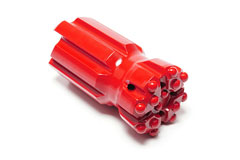
| Drill bit | The cutting tool that directly contacts and fractures the rock; available in various face designs and button configurations for different rock types |
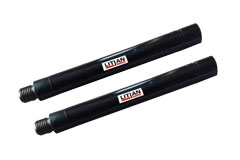
| DTH hammer | The percussive mechanism located behind the bit; contains a piston that delivers rapid impacts to fracture rock |
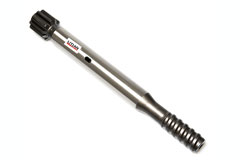
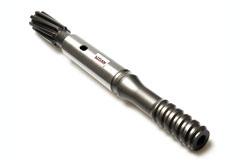
| Drill rods | Hollow steel tubes that connect the hammer to the surface rig; transmit rotation and feed force while delivering air or fluid to the hammer |
| Power source | Compressed air system (for pneumatic hammers) or high-pressure water system (for water-powered hammers); provides energy for hammer operation and cuttings removal |
| Rotary head / Feed system | Provides rotation and downward feed force to advance the drill string |
DTH drilling is used across a wide range of industries and applications:
Mining: Blast hole drilling in open-pit and underground mines
Construction: Foundation drilling, shaft sinking, tunnel excavation, and pile drilling
Water well drilling: Drilling water wells in hard rock formations
Oil and gas: Exploration and production drilling
Geothermal: Deep geothermal well drilling
Quarrying: Production drilling in granite, limestone, and other hard rock quarries
Geotechnical exploration: Mineral exploration and geological coring
DTH drilling is particularly well-suited for hole diameters of 4 to 10 inches (100–250 mm), with some applications reaching up to 24 inches or more. The method excels in hard rock formations where conventional rotary drilling would be slow or inefficient.
Because the hammer is located at the bottom of the hole, impact energy does not diminish as the hole deepens. In top hammer drilling, energy is lost through the drill string, reducing efficiency in deep holes. DTH drilling maintains a more or less constant penetration rate regardless of hole length.
DTH drilling achieves higher penetration rates than conventional rotary drilling in rock. Air DTH hammer drilling has long been recognized as having the potential to drill faster than conventional rotary drills, especially in hard rocks such as granite, sandstone, limestone, and dolomite.
The rigid drill string and direct impact at the bottom of the hole contribute to superior hole straightness. DTH drilling ensures vertical, straight boreholes, which is critical for applications where foundation alignment and structural accuracy are critical.
DTH technology ensures high penetration rates, precise alignment and reliable performance in challenging geological conditions, making it ideal for infrastructure, energy, and industrial projects.
Water-powered DTH drills produce less dust, vibration, and noise compared to air-powered or top hammer systems, making them ideal for urban construction and environmentally sensitive sites.
DTH drilling requires a compressed air system and specific setup. High-capacity air compressors are necessary, which adds to equipment cost and energy consumption.
The compressed air requirements result in higher energy consumption and operational costs compared to simpler drilling methods.
DTH tools experience increased wear in abrasive formations. Internal components wear over time, which can cause the penetration rate to reduce considerably.
Air-powered DTH systems are highly sensitive to water production during formation. Excessive water inflow can deteriorate air circulation performance in the borehole, substantially limiting the applicability of this technology.
DTH drilling is not necessary in soft or cohesive soils where simpler technologies are sufficient.
Air-powered DTH hammers are less effective at greater depths (>4,000 m) due to the difficulty of removing cuttings and overcoming the ingress of fluids and hydrostatic heads.
Water-powered DTH hammers require a large flow rate of high-quality water to drive the hammer tool. Most fluid hammers suffer from performance issues when drilling deeper, as the volumes of water required for proper hole cleaning are too great for the piston to cycle effectively.
DTH drilling has earned its place as one of the most reliable and efficient methods for hard rock penetration. By placing the hammer directly behind the bit, it eliminates the energy losses that plague top hammer systems in deep holes, delivering consistent performance regardless of depth.
The method is not without its trade-offs. The requirement for high-capacity compressed air systems, increased tool wear in abrasive formations, and sensitivity to water ingress are real limitations that must be considered when selecting a drilling method.
However, for applications that demand deep, straight holes in hard rock—whether in mining, construction, water well drilling, or geothermal exploration—DTH drilling remains the method of choice. Its ability to maintain high penetration rates, excellent hole quality, and reliable performance in challenging geological conditions makes it an indispensable tool in modern drilling operations.
When choosing between DTH and other drilling methods, consider your specific project requirements: hole depth, diameter, rock hardness, and site conditions. For shallow holes in softer rock, top hammer may be more economical. For deep holes in hard rock, DTH is almost always the superior choice.
Q1: What is the main difference between DTH and top hammer drilling?
The main difference is the location of the hammer. In top hammer drilling, the hammer is at the surface and impact energy travels down the drill string. In DTH drilling, the hammer is at the bottom of the hole directly behind the bit, delivering impact energy directly to the rock with minimal loss. DTH drilling is better suited for deeper holes, while top hammer is more efficient for shallow holes.
Read more: What is the difference between top hammer drilling and DTH drilling?
Q2: What hole diameters are DTH drills best suited for?
DTH drilling is most suitable for hole diameters of 4 to 10 inches (100–250 mm), with some exceptions for larger or smaller diameters. Top hammer drills typically dominate below 4 inches, while DTH takes over above that threshold.
Q3: Why does DTH drilling maintain consistent penetration rates at depth?
Because the hammer is located at the bottom of the hole directly behind the bit, impact energy does not have to travel through a long drill string. In top hammer drilling, energy is lost through the drill string as the hole deepens. DTH drilling delivers energy directly to the rock face regardless of hole depth.
Q4: What are the main limitations of DTH drilling?
Key limitations include: requirement for a compressed air or high-pressure fluid system; higher energy consumption and operating costs; increased tool wear in abrasive formations; sensitivity to water ingress for air-powered systems; and reduced effectiveness at extreme depths (>4,000 m) for air systems.
Read more: Best Drilling Tools for Underground Tunneling Projects
Q5: When should I choose DTH drilling over top hammer drilling?
Choose DTH drilling when you need to drill deep holes (typically >20–30 m), larger diameter holes (>4 inches), or when drilling in hard rock formations where consistent penetration rates and hole straightness are critical. Top hammer is generally more economical for shallow holes in softer rock.
"Experimental study on the influence of confining pressure on borehole bottom rock damage in pneumatic down-the-hole hammer drilling" – ScienceDirect, 2026. https://www.sciencedirect.com
"Numerical simulation of rock fragmentation in DTH hammer drilling" – ScienceDirect, 2022. https://www.sciencedirect.com
"Study on the rock-breaking effect of DTH hammer drilling under different impact frequencies" – ScienceDirect, 2024. https://www.sciencedirect.com
"Geo-Drill Project: Exploring Down Hole Hammer Drilling for Geothermal" – World-Energy.org, July 2020. https://www.world-energy.org/article/11071.html
"Drilling & Blasting – P&Q University Handbook" – Pit & Quarry (industry publication). https://stage.pitandquarry.com/drilling-blasting-pq-university-handbook/3/
This is the first one.

Litian is a professional manufacturer focused on the production of rock drilling tools and excavation tools.
Learn More >