English
 中文
中文 Español
 русский
 français
 português
 العربية
 Deutsch
 italiano
 한국어
한국어 Polska
×
If you've been in rock drilling for any length of time, you know the frustration all too well. You're making good progress, penetration rates are steady, and then suddenly—a button is gone. The bit pulls out of the hole with an empty socket where a tungsten carbide insert used to be. The drilling slows down, the hole quality suffers, and you're left wondering: what went wrong?
Button loss is one of the most common—and costly—failure modes in rock drilling. But the good news is that in the vast majority of cases, it's preventable. Understanding why buttons fall off is the first step toward keeping them where they belong.
A missing button isn't just a minor inconvenience. When a tungsten carbide button is lost, the bit's cutting structure is compromised. The remaining buttons must work harder, leading to accelerated wear on the entire bit. Penetration rates drop, energy is wasted, and the risk of hole deviation increases. In some cases, a bit that has lost multiple buttons must be pulled from service entirely—long before its expected lifespan.
Worse, lost buttons can become debris in the hole, potentially causing damage to downstream equipment or creating hazards in the drilling operation.
So why does this happen?
Industry experts estimate that 90% of all button failures are the direct result of continuing to drill with excessive wear flats on the buttons. When a button develops a flat wear surface, the impact energy from the rock drill is no longer concentrated on a small area. Instead, it spreads out across the flat, generating excessive heat and stress that propagate into the carbide-steel interface. Over time, this weakens the bond that holds the button in place, eventually causing it to shear off or fall out.
The telltale sign? Buttons that look polished, shiny, or flat—especially on the face of the bit. When wear flats exceed approximately one-third of the button diameter, you're in the danger zone.
In non-abrasive rock formations—such as limestone or certain types of sandstone—the tungsten carbide buttons wear very slowly. The steel bit body, however, can erode much faster. When the steel around a button wears away more quickly than the button itself, the button becomes over-exposed. A button that protrudes too far from the bit face lacks proper support and is vulnerable to shearing off under impact.
This is particularly common in fractured or loose formations where constant hole cleaning and re-drilling accelerate body wear.
Drilling creates rock cuttings that must be continuously removed from the hole. If the flushing system—whether air or water—is inadequate, cuttings accumulate at the bottom of the hole. These cuttings are abrasive. They get trapped between the bit face and the rock, grinding against the bit body and buttons repeatedly. This abrasive action accelerates body wear, generates excessive heat, and can physically knock buttons loose over time.
Operators who continue drilling with poor bailing will find that bit bodies wear excessively—and buttons follow shortly after.
A rock drill is designed to deliver impact energy when the bit is firmly seated against solid rock. When the bit is not in full contact with the bottom of the hole—such as when collaring on uneven surfaces, clearing a jam, or retracting—engaging full percussion can cause what's known as “dry firing.” The impact energy has nowhere to go except back into the bit itself, which can shatter buttons or knock gauge buttons loose.
This is a particular risk in broken or fractured ground where the bit may hang up or fail to seat properly.
Drilling generates heat—sometimes a lot of it. Under normal conditions, the flushing system cools the bit effectively, keeping tool temperatures below 40°C (104°F). But when flushing is insufficient or the bit is over-drilled, temperatures can rise sharply. Repeated heating and cooling cycles cause thermal fatigue in the carbide, leading to micro-cracks at the carbide-steel interface. These cracks propagate over time, eventually causing the button to detach.
A visible sign of thermal fatigue is a “snake-skin” or cracked texture on the button surface, indicating that the carbide has been overheated.
Every rock formation has an optimal combination of rotation speed, feed pressure, and impact energy. When these parameters are mismatched, buttons suffer. Excessive feed pressure can shear buttons directly off the bit. Insufficient rotation leads to button glazing and polishing, which accelerates flat development and leads to over-drilling. Harder ground conditions combined with excessive rotation create wear that is concentrated on the bit circumference, leading to gauge button loss.
Not all button bits are created equal. Inferior welding or brazing techniques, poor-quality carbide, inadequate heat treatment, or improper interference fit between button and socket can all contribute to premature button loss. A bit that loses buttons early in its life—before significant wear has occurred—should raise a red flag about manufacturing quality.
The single most effective way to prevent button loss is to regrind buttons before flats become excessive. Industry best practice recommends regrinding when wear flats reach approximately one-third of the button diameter, or when penetration rate drops by 10–15%. Delaying regrinding forces the drill to work harder, increases vibration, and dramatically raises the risk of button failure. Proper regrinding can restore 80–90% of original performance and allow multiple cycles before the bit body reaches its wear limit.
Never compromise on flushing. Check that flushing channels are clear before each use. Blocked channels are a hidden killer—they cause localized overheating, button spalling, and premature body erosion. In deep holes common in tunneling, consider periodic back-flushing during operations to maintain clear paths. If bailing appears inadequate, clean holes thoroughly after drilling each steel length.
There is no such thing as a universal drill bit. Different rock formations require different bit face designs and carbide grades. In hard rock such as granite, flat-face bits provide the robust structure needed to withstand high impact forces. In medium-hard rock with voids or fractures, concave bits facilitate rapid chip evacuation. Selecting the wrong bit for the formation accelerates wear and increases button loss risk.
Never engage full percussion unless the bit is seated firmly against solid material. Use reduced percussion when collaring on uneven surfaces, when the bit hangs up in the hole, or when rattling the drill string to loosen connections.
Adjust rotation speed and feed pressure according to rock conditions. In hard rock, use lower rotation speeds and appropriate feed pressure to prevent excessive gauge wear. In softer formations, parameters can be adjusted upward, but always monitor wear patterns and adjust accordingly. Keeping a simple drilling log—noting meters drilled, rock type, penetration rate changes, and observed wear patterns—helps forecast regrinding intervals more accurately than fixed schedules.
Establish a proactive inspection routine. Examine bits after every shift or every 50–100 meters drilled in hard rock. Look for early warning signs: uneven button flattening, micro-cracks at the carbide-steel interface, body wash near gauge buttons, and polished or glazed button surfaces. Catching problems early is always cheaper than dealing with a failed bit in the hole.
Finally, start with a quality product. Button bits made from high-grade alloy steel and premium tungsten carbide, with proper heat treatment and precision brazing, are fundamentally more resistant to button loss. While quality tooling may have a higher upfront cost, the reduction in downtime, longer bit life, and lower cost per meter make it the smarter investment.
Not every bit can be saved. Replace a button bit when:
Gauge buttons are missing or severely damaged
The bit body is worn down to the point where buttons have inadequate support
Multiple face buttons are missing
Cracks are visible in the bit body between button sockets
A drill bit can remain in service as long as the gauge buttons maintain the diameter of the bit. Once that diameter is compromised, replacement is the only option.
Button loss is rarely a mystery. In most cases, it's the result of over-drilling, inadequate flushing, mismatched drilling parameters, or a combination of these factors. By adopting a proactive maintenance approach—regular inspections, timely regrinding, proper flushing, and matching bits to formations—you can dramatically reduce button loss and get more meters per bit.
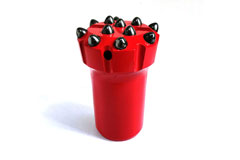
At Litian Heavy Industry, our threaded button bits are engineered with premium carbide grades and heat treatment specifically for sustained performance in hard rock environments. Whether you're drilling in abrasive granite, fractured sandstone, or anything in between, we have solutions designed to keep buttons where they belong—breaking rock.
Ready to improve your drilling performance? Contact us to discuss your specific application, or browse our threaded button bit product line to find the right tool for your ground conditions.

Litian is a professional manufacturer focused on the production of rock drilling tools and excavation tools.
Learn More >