English
 中文
中文 Español
 русский
 français
 português
 العربية
 Deutsch
 italiano
 한국어
한국어 Polska
×
Choosing the right threaded button bit for hard rock drilling is one of the most important decisions you'll make on any drilling project. Get it right, and you'll enjoy faster penetration, longer bit life, and lower cost per meter. Get it wrong, and you'll face premature wear, slow progress, and frequent tool changes.
Two of the most common thread sizes in top hammer drilling are T45 and T51. But what's the real difference between them, and how do you know which one is right for your hard rock application?
This guide breaks it down.
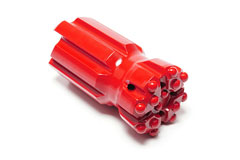
Button bits are rock drilling tools with tungsten carbide inserts—called buttons—that fracture rock through impact and rotation. The "T" in T45 and T51 denotes a trapezoidal thread, a thread form widely used in top-hammer drilling systems. T45 and T51 are two common thread sizes in the T-series family, which also includes T38, T45, T51, and larger sizes like GT60 and T60.
The number refers to the nominal thread diameter, with larger numbers indicating larger thread dimensions and greater load capacity. As thread size increases, so does torque capacity and the range of hole diameters the bit can handle.
In terms of hole diameter coverage:
T45 button bits are suitable for approximately 76–127 mm hole diameter
T51 button bits are suitable for approximately 89–127 mm+ hole diameter
Larger thread size generally means higher torque capacity and support for larger hole ranges. Both thread types are designed for bench drilling, long-hole drilling, and tunneling applications, with availability in a range of head diameters, face designs (Flat Face, Drop Center, Uni-face), and button shapes (Dome, Ballistic, Semi-Ballistic).
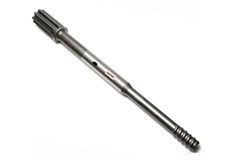
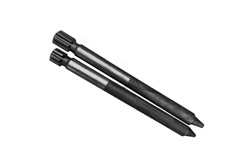
One of the most important technical differences between T45 and T51 systems is their torque tolerance. T51 rods have greater mass and stiffness than T45 rods, which allows them to transmit higher torque over longer drill strings without binding.
If you're stepping up to T51 rods in harder material, it's essential to verify that your rig's rotation motor can sustain the torque demand across the drill string. Some mid-duty drilling units cannot meet the torque requirement for a 15-meter T51 string, and that's a selection-stage check you want to make in advance—not discover on-site.
For jobs requiring very deep holes or highly controlled straightness, the extra torsional rigidity of T51 may be worth the investment.
Hard rock drilling demands high impact energy. T51 button bits, with their larger thread cross-section, are generally more tolerant of high impact loads than T45 bits. That said, a well-designed T45 bit from a quality manufacturer can still deliver exceptional performance in all types of rock. The choice between them often comes down to balancing your specific drilling parameters against the rock conditions you're facing.
Larger thread sizes come with larger bit bodies and heavier components. T45 bits and rods are lighter and easier to handle than T51, which can be a practical consideration for jobs requiring frequent manual rod changes, or for use with lighter-duty drills where weight capacity is limited.
Regardless of whether you choose T45 or T51, your button shape is equally critical to success in hard rock drilling.
Granite, basalt, and quartzite—the classic hard rock formations—are typically hard and abrasive. For such conditions, spherical button bits are the most reliable option. Their rounded geometry distributes impact stress evenly across the carbide surface, providing higher wear resistance, better fracture resistance, and longer service life compared to other button shapes.
Here's how different button shapes perform:
Spherical buttons: Built for durability. They work by crushing rock, not cutting it. The rounded profile distributes impact force over a wider surface area, reducing stress on any single point of the carbide and preventing fractures. This makes them the only real choice for drilling the toughest conditions like quartzite, granite, and basalt.
Ballistic buttons: Designed for higher penetration efficiency, with faster drilling speed but lower durability. They’re best suited for medium-hard rock or softer formations where speed matters more than wear life.
Parabolic buttons: Offer a balance between speed and durability for mixed or moderately abrasive conditions.
For high-UCS hard rock (150 MPa+), spherical buttons are strongly preferred. The marginal gain in penetration speed from ballistic buttons typically comes at the cost of significantly shorter bit life—which translates to more downtime, more bit changes, and a higher total drilling cost over the life of your project.
For hard rock applications, flat or concave face designs generally improve stability. Convex head designs with fewer, larger hemispherical buttons (180° tip angle) can help concentrate impact energy and resist wear in extremely hard formations.
Large flushing holes on bit face are beneficial for efficient chip evacuation, preventing regrinding and overheating. In highly abrasive formations, retractable button bits (Retrac) with reinforced gauge buttons can help prevent bit jamming and extend overall gauge life.
Not all button bits are created equal. The grade of tungsten carbide used in the buttons directly affects wear life and fracture resistance.
For granite and other ultra-hard formations, a carbide grade with higher hardness (YK05, ~91 HRA) is typically chosen, though this often comes with slightly lower toughness. For abrasive sandstone or mixed ground with high quartz content, a grade that balances hardness with toughness (YG11C/K40) may deliver better overall life.
Premium carbide grades resist wear and thermal cracking significantly better than standard grades.
Your required hole diameter is within the T45 range (76–127 mm)
You’re drilling at moderate depths where torque demand is manageable with lighter drill rods
You’re working with medium-hard rock or mixed ground where the additional torque capacity of T51 isn’t strictly necessary
Weight and handling are practical concerns—T45 components are lighter and easier to manage
T45 button bits are widely used in bench drilling, underground long-hole drilling, and applications requiring compatibility with extension MF rods.
You’re drilling deep holes requiring longer rod strings and greater torque transmission
Your required hole diameter exceeds 100mm toward the upper end of T45 capability (T51 goes to 127mm+)
You’re drilling in extremely hard, competent rock (UCS 150 MPa+ or f=8~18)
Your drill rig has sufficient rotation motor output to handle the torque demands of a full T51 string
Minimizing energy loss and maximizing hole straightness are critical objectives
The thread is the critical bridge between the impact energy of the drifter and the resistance of the rock. Choosing the correct thread size ensures that every joule of energy reaches the rock face efficiently.
Hard rock drilling generates large volumes of fine, sharp rock cuttings. Efficient chip removal through the flushing holes is essential for both performance and tool life. Poor flushing can cause cuttings to be reground at the hole bottom, accelerating wear on both buttons and bit body.
Regular inspection is also crucial. For spherical buttons in hard rock, regrinding should be performed before wear flats exceed approximately one-third of the button diameter. This practice restores penetration rate and prevents stress buildup that can lead to button fracture.
Proper maintenance of the threaded connections themselves is equally important. Keep threads clean and free of debris, apply appropriate lubrication, and torque connections to the manufacturer's specifications to prevent thread galling and energy loss.
To summarize the T45 vs. T51 selection decision for hard rock drilling:
| Factor | T45 | T51 |
| Hole diameter range | 76–127 mm | 89–127 mm+ |
| Torque capacity | Moderate | High |
| Rod weight | Lighter | Heavier |
| Best rock application | Medium-hard to hard | Very hard/abrasive |
| Typical hole depth | Shallow to moderate | Deep |
A good starting point: For bench blasting in granite or basalt at moderate depths (less than 20 meters of total string length), T45 with spherical buttons is often the most cost-effective answer. For long-hole ore pass drilling in competent hard rock exceeding 150 MPa UCS, or for holes deeper than 20 meters where rod stiffness becomes critical, T51 is generally the stronger choice.
And when in doubt, consult your drill rig's specifications, match your rock conditions to the right button shape and carbide grade, and choose quality tooling from a reputable manufacturer—because in hard rock drilling, the upfront decision you make today determines the cost you pay per meter tomorrow.
This is the first one.

Litian is a professional manufacturer focused on the production of rock drilling tools and excavation tools.
Learn More >