English
 中文
中文 Español
 русский
 français
 português
 العربية
 Deutsch
 italiano
 한국어
한국어 Polska
×
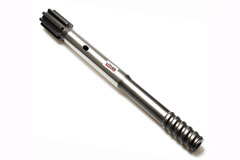
Drill rod threads are the most vulnerable link in any drill string. Despite being a small fraction of the total drilling cost—typically about 3 percent—thread failures account for a disproportionately large share of downtime, repair expenses, and lost productivity. In fact, connection failure has been identified as the principal cause of drillstring equipment failure, accounting for 58% of all drillstring failures. The most common place for drill pipe to fail is in the threads.
Understanding why threads fail—and how to prevent it—is essential for anyone who wants to keep drilling operations productive and profitable.
When a drill rod thread fails, the consequences extend far beyond replacing a single rod. A failed thread can:
Cause a twist-off, leaving expensive tooling lost downhole
Damage mating threads on adjacent rods, spreading the problem through the entire inventory
Trigger cascading failures that compromise the entire drill string
The financial impact is significant. Re-drilling a hole for one month can increase costs by 9 percent. A rod retired early is always cheaper than a rod that fails in the hole.
Galling is the most common way drill rods fail. It occurs when mating thread surfaces of similar hardness adhere to each other under pressure, causing material to transfer from one surface to another.
Causes of galling:
Using grease instead of proper thread compound—grease is not thread compound
Machine misalignment during make-up
Mechanism: The rate of adhesion wear decreases as surface hardness increases. When mating surfaces have similar hardness, the adhesion between them is stronger, accelerating wear. Studies show that a system with dissimilar hardness can extend useful life several times over one with similar hardness.
Fatigue failures are brittle failures that occur under stress or load levels significantly below static load ratings but applied or cycled a large number of times.
Key findings from case studies:
A detailed examination of failed drill rods manufactured from 22NiCrMo12-5F steel found that failure occurred due to the initiation and propagation of fatigue microcracks at the outer surface of the thread
Multiple short cracks were observed on the fracture surface, propagating perpendicularly to the impacting direction
Two different crack initiation mechanisms were identified: crack initiation from pits and crack initiation from severe plastic surface deformation
The stress concentration located at the groove of threads at the joint was likely to cause crack initiation
Propagation of fracture was observed with evidence of beach marks—a classic indicator of progressive fatigue crack growth under cyclic loading
Contributing factors:
Critical insight: Lower make-up torque results in lower contact pressure of the main shoulder and reduction of thread fatigue strength. Multisource fatigue cracks form at the root of the thread due to stress concentration.
Similar to the steel-on-steel wear of the joints, the box end is subject to abrasive wear against the wall of the drill hole. This wear can compromise the integrity of the connection and accelerate thread failure.
Drill pipe threads are engineered to be made up to a specific makeup torque before going in the hole. If the proper makeup torque is not reached, the threads will continue trying to make up downhole while rotary drilling. The vibrations from the bit combined with the torque from the rig create a rotary jackhammer effect on the threads, which causes galling.
Thread dope is a magnet for dust, dirt, rocks, and sand. These foreign materials cause friction in the connections, and friction causes galling. Even "clean" jobsites expose threads to abrasive particles that accelerate wear.
Thread compound is critical to the life of a joint. A poor choice of compound—or diluted compound—can provide insufficient friction or allow mating surfaces to interact, resulting in adhesive wear.
Best practices:
Use compounds containing at least 50% zinc particulate, which provide higher friction factor and better resistance than those containing copper, lead, or graphite
Apply thread compound to every joint, every time rods are threaded together
Cover the entire area of the pin and box threads with compound before every make-up
Never substitute grease for thread compound—they serve different purposes
Use fresh dope; old dope contaminated with debris accelerates wear
Daily thread maintenance is essential:
Clean and lubricate joints regularly, preferably after every break
Inspect pin ends regularly for signs of damage or "mushrooming"
Use a thread profile gauge for accurate assessment of thread condition
Use hydraulic tools to apply the minimum make-up torque required
Follow manufacturer torsional specifications for minimum and maximum makeup torque
Stab gently and let threads find their way—never drive the pin against the box shoulder
Always come out of the hole slowly; never pull back while unscrewing
Use only non-damaging tools (e.g., rubber mallet) when breaking rod joints
Store rods on sturdy racks, off the ground, and away from harsh weather
Install thread protectors immediately, prior to storage or transport
A sub saver helps protect your drill rod investment by connecting the drive chuck to the drill rod. "Sub saver maintenance is crucial," note industry experts. "Changing the sub saver often to preserve the thread will help to prevent thread damage from rod to rod".
Check your sub saver with a thread gauge during daily inspections. When you can see through the teeth, replace it right away. Waiting too long risks damaging threads across your entire drill string.
Different manufacturers may not hold critical tolerances identically. When critical measurements are not maintained during the manufacturing process, the mating of pin and box may be incorrect and cause the connection to be flawed, leading to premature failure. Mixing rods from different manufacturers can cause equipment failure and operator injury.
If the machine is allowed to move during operation, you run the risk of galling or prematurely wearing or damaging the threads on your drill rod. Always fully torque your drill stem to prevent pipe from unscrewing or breaking pins off during the bore.
| Failure Mode | Primary Prevention |
| Galling | Use thread compound with ≥50% zinc; clean threads before every connection |
| Fatigue cracking | Apply proper makeup torque; avoid severe stabbing; reduce deviation and drilling loads |
| Box wear | Clean threads; use thread protectors; inspect regularly |
| Insufficient makeup torque | Follow manufacturer torque specifications; use hydraulic tools |
| Contamination | Clean threads between jobs; install thread protectors during storage |
| Cross-manufacturer mixing | Use rods from a single manufacturer exclusively |
Recognizing when to retire a drill rod prevents costly in-bore failures. Watch for:
Any pin or box that is badly damaged will severely damage every stick of pipe that you make up with it.
Drill rod thread failures are not random accidents—they are predictable consequences of preventable causes. Galling, fatigue cracking, and insufficient makeup torque account for the vast majority of thread failures. Each of these failure modes can be controlled through proper maintenance, correct thread compound selection, adherence to torque specifications, and regular inspection.
The principles are straightforward:
Clean threads before every connection—dirt is the enemy
Use the right thread compound—with at least 50% zinc content
Apply proper makeup torque—follow manufacturer specifications
Inspect daily—catch problems before they cause failures
Don't mix manufacturers—maintain consistency in your drill string
Replace sub savers regularly—protect your rod threads
Your drill rods represent a significant investment. With proper care and attention to threads—the most vulnerable part of the drill string—you can extend their life, reduce downtime, and keep your drilling operations productive.
Q1: What is the most common cause of drill rod thread failure?
Thread galling—adhesive wear between mating steel surfaces—is the most common way drill rods fail. It occurs when mating surfaces of similar hardness adhere under pressure, often caused by high torque without proper thread compound, dirt on threads, or using grease instead of proper thread compound.
Read more: Basic Requirements for Threaded Drill Rod
Q2: How can I tell if a thread failure is caused by fatigue?
Fatigue failures are characterized by beach marks on the fracture surface—concentric rings that indicate progressive crack growth under cyclic loading. The crack typically initiates at the thread root where stress concentration is highest, and multiple short cracks may be visible on the fracture surface.
Read more: Causes And Solutions Of Drill Rod Fracture
Q3: Why is thread compound with 50% zinc recommended over other types?
Compounds containing at least 50% zinc particulate provide a higher friction factor and better resistance than those containing copper, lead, or graphite. Zinc-based compounds offer superior protection of mating metal surfaces and help prevent galling under high torque conditions.
Read more: How to Maintain the Threaded Drill rod?
Q4: What happens if drill rod threads are not made up to proper torque?
If proper makeup torque is not reached, threads will continue trying to make up downhole while rotary drilling. This creates a rotary jackhammer effect on the threads that causes galling. Lower makeup torque also results in lower contact pressure and reduced thread fatigue strength, making the connection susceptible to fatigue cracking.
Read more: Common Mistakes to Avoid When Using Drill Extension Rods
Q5: Can I mix drill rods from different manufacturers?
No. Mixing rods from different manufacturers can cause equipment failure and operator injury due to variations in thread dimensions and material properties. Different manufacturers may not hold critical tolerances identically, and when these measurements are not maintained, the mating of pin and box may be incorrect.
Read more: What Is Drill Rod and Drill Rod Sizes?
Trenchless Technology. "The Rotation Rule" and "Thread TLC." April 2025, Page 45. https://digital.trenchlesstechnology.com/april-2025/page-45
Trenchless Technology. "The Most Common Causes of Drill Pipe Failure." HDD Guide 2023. https://digital.trenchlesstechnology.com/articles/the-most-common-causes-of-drill-pipe-failure
Trenchless Technology. "Care and Maintenance of Rotary-Shouldered Connections." April 2020, Page 50. https://digital.trenchlesstechnology.com/april-2020/page-50
Failure analyses and wear mechanisms of rock drill rods, a case study. Elsevier, Engineering Failure Analysis, 2019. https://www.sciencedirect.com/science/article/abs/pii/S1350630718314420
Chaijaruwanich, Anirut and Thongthip, Chatchanok. "Failure Analysis of Hydraulic Rotary Drill Rods in a Limestone Mine." International Journal of Mechanical Engineering and Robotics Research, Vol. 5, No. 4, October 2016, pp. 251-254. DOI: 10.18178/ijmerr.5.4.251-254. https://www.ijmerr.com/show-143-761-1.html
Gong Dan-mei, Yu Shi-jie, et al. "Cause Analysis on Pricking Leakage of Double-shoulder Drill Rod Joint." Failure Analysis and Prevention, 2014, 9(2): 104-109. http://qk.nchu.edu.cn/sxfxyyf/en/article/doi/10.3969/j.issn.1673-6214.2014.02.010
This is the first one.

Litian is a professional manufacturer focused on the production of rock drilling tools and excavation tools.
Learn More >