English
 中文
中文 Español
 русский
 français
 português
 العربية
 Deutsch
 italiano
 한국어
한국어 Polska
×
Granite quarries demand the most robust quarrying tools available, with rock hardness exceeding 180 MPa and extreme durability requirements. Top hammer drilling remains viable in many granite operations, particularly for dimension stone and smaller aggregate production. This technical deep dive explores specialized stone drilling tools selection, operational strategies, and performance optimization for granite's unforgiving environment.
Granite is an igneous rock with interlocking crystals of quartz, feldspar, and mica. Its high compressive strength and low porosity create unique drilling challenges:
Exceptional resistance to penetration requires maximum impact energy
Crystalline structure transmits shock waves efficiently but resists fracturing
Micro-fractures from blasting affect hole stability
Thermal expansion differences cause spalling under heat stress
Rock drilling equipments must deliver consistent, high-energy impacts while maintaining precision for dimension stone blocks.
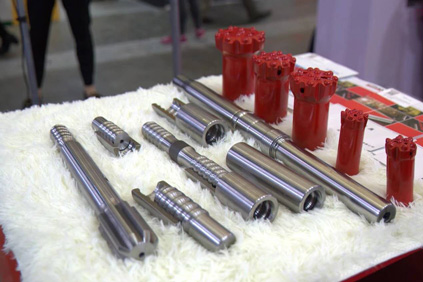
Spherical button bits are mandatory for granite. The dome-shaped carbide inserts distribute stress evenly, preventing fracture under extreme loading. Button diameters of 14–16 mm provide necessary impact surface area.
Premium carbide grades (YK05 or equivalent) with 5–6% cobalt binder offer optimal hardness/toughness balance. The low cobalt content maximizes wear resistance while maintaining shock absorption. Quarrying drill tools with consistent carbide quality ensure predictable performance.
Drop center face designs improve hole straightness in granite's uniform structure. The concave profile creates self-guiding action, reducing deviation to <0.5% over 10 meters. Flushing holes must be 8–10 mm to handle coarse granite cuttings.
Center flushing bits excel in deep holes, preventing packing in the bit face. High-pressure air (28–32 bar) is essential for cuttings removal in dry drilling. Water flushing risks thermal shock to carbide buttons.
Top hammer rigs for granite need 25–35 kW impact power. Common models include:
Sandvik Ranger DX800
Epiroc SmartROC T40
Atlas Copco FlexiROC T45
Thread systems progress from T38 (smaller holes) to T51 (production blasting). Quarry drills must maintain precise rotation control to prevent button overheating.
Granite demands specific drilling parameters:
| Parameter | Optimal Range | Purpose |
|---|---|---|
| Rotation Speed | 60–90 RPM | Heat control |
| Percussion Energy | 90–100% max | Rock fracturing |
| Feed Pressure | 80–120 bar | Button contact optimization |
| Air Pressure | 28–32 bar | Cuttings removal |
Slow rotation prevents thermal cracking of carbide. Maximum percussion ensures fracture propagation through crystal boundaries.
Precision is paramount in dimension stone quarries:
Use laser guidance for hole alignment
Drill line holes with 50–100 mm spacing
Maintain parallel holes within 10 mm over 6 meters
Employ half-barrel bits for corner holes
Stone drilling tools must produce clean, straight holes to facilitate wire sawing or splitting.
Granite veins often require narrow hole patterns. Quarrying tools with reinforced gauge buttons prevent premature wear. Hardfacing on bit bodies extends life in confined spaces.
Regular gauge measurement ensures hole diameter consistency. When gauge reduces by 1.5 mm, bit effectiveness drops significantly due to reduced flushing efficiency.
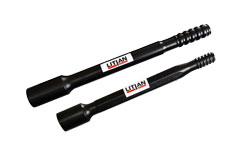
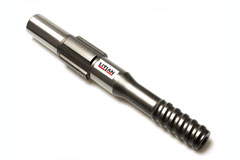
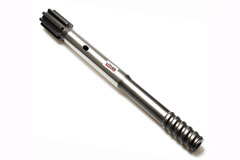
Heavy-duty MF rods with T45 or T51 threads handle granite's resistance. Wall thickness must be sufficient to prevent buckling under compression. Carburized rod bodies resist surface wear from granite particles.
Rod length selection depends on bench height—typically 4.3–6.1 meters. Drilling tools for mining require torque ratings matching rig capacity to prevent thread damage.
Granite drilling generates significant heat. Air cooling is preferred over water to prevent thermal shock. Monitor bit temperature—above 400°C risks carbide phase changes and brittleness.
Rotation speed control is critical. Excessive RPM creates friction heat without penetration gains. Modern quarry drilling machine systems with temperature feedback adjust parameters automatically.
Performance Metrics for Granite
| Metric | Target Value | Industry Standard |
|---|---|---|
| Penetration Rate | 0.6–1.0 m/min | 0.8 m/min |
| Bit Life | 800–1500 meters | 1000 meters |
| Hole Straightness | <0.5% deviation | 1% |
| Energy per Meter | 35–45 kWh/m | 40 kWh/m |
Granite dust contains crystalline silica requiring stringent controls:
Wet suppression mandatory in enclosed areas
Respiratory protection with PAPR systems
Regular air monitoring for compliance
Enclosed, filtered operator cabs

Litian is a professional manufacturer focused on the production of rock drilling tools and excavation tools.
Learn More >