English
 中文
中文 Español
 русский
 français
 português
 العربية
 Deutsch
 italiano
 한국어
한국어 Polska
×
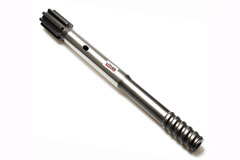
A shank adapter (also called a striking bar) is the critical interface between the rock drill's percussion mechanism and the drill string. It transmits impact energy, rotation torque, feed force, and flushing medium to the drill rod and bit. For a deeper understanding of how this component works, see our detailed explanation: What Is the Function of Rock Drill Shank Adapter?
Selecting the correct shank adapter is essential because a mismatch can lead to energy loss, premature tool failure, and costly downtime. In fact, improving tool quality and maintenance can recover 5–15% of percussion energy that would otherwise be lost at string interfaces. This guide walks you through the key selection criteria, thread types, rock drill compatibility, and maintenance best practices.
In the entire drill string, the shank adapter experiences the highest stress per unit volume. The rock drill piston strikes it directly at frequencies of 30–65 Hz, transmitting both axial compression and torsional load simultaneously. This means the adapter must absorb and relay immense forces with minimal energy loss—making precise selection a make-or-break factor in drilling productivity.
Poor thread condition, dimensional mismatches, or incorrect material selection at any interface reduces the energy available at the drill bit without changing anything on the drifter itself. A mushroomed strike face—where the shank end that contacts the piston has deformed from cumulative impact—changes how the stress wave enters the shank, reducing transmission efficiency and signaling it is time for replacement.
The first and most essential requirement is that the shank's thread type must exactly match the drill rig's interface to ensure correct connection and efficient operation. Thread forms used in top hammer shank adapters fall into two main families:
| Thread Family | Specifications | Typical Application | Impact Power |
| R-type (Rope Thread) | R25, R28, R32, R35, R38 | Lower-power drills, bolting, light tunneling | Relatively lower impact energy |
| T-type (Trapezoidal Thread) | T38, T45, T51 | Medium to high-power hydraulic drills, hard rock | High impact energy |
| ST-type (Super Trapezoidal) | ST58, ST68 | Ultra-heavy-duty drills, large-diameter holes | Very high impact energy |
| GT-type | GT60 | High-power drifting and tunneling | High impact energy |
R-type threaded shanks are suitable for lower-power drills and applications like rock bolting and light tunneling. They perform reliably in moderate-strength rock conditions. T-type threaded shanks are the heavy-duty choice, designed for high-impact hydraulic drills working in very hard rock. The T-thread's structure effectively solves jamming issues that R-threads can experience, making them the preferred option for high-power drills. The world-standard R32 tool joint, for example, performs well for rock drills with impact power ratings up to about 15 kW, beyond which a more robust system like T38 or T45 is required.
Shank adapter geometry must match the specific drifter model. Epiroc COP, Sandvik HL/RD, and Furukawa HD/PD shanks are not interchangeable, even if they share the same thread designation. For instance, a T45-thread shank for an Atlas Copco COP1838 will have different spline dimensions, overall length, and strike face geometry compared to a T45 shank for a Sandvik HL700.
Below is a comprehensive compatibility reference table matching common rock drill brands and models to their appropriate shank adapter thread types:
| Rock Drill Brand | Common Drifter Models | Compatible Thread Types |
| Atlas Copco / Epiroc | COP 1032/1036/1038/1132/1238 | R32, R38, T38, T45 |
| Atlas Copco / Epiroc | COP 1440/1550/1638/1838/2238 | T45, T51 |
| Atlas Copco / Epiroc | COP 2550UX | T51 |
| Atlas Copco / Epiroc | BBC 51/52/54/120 | R32, R38 |
| Sandvik / Tamrock | HL300/HL300S | R32, R38 |
| Sandvik / Tamrock | HL438/HL538 | T38 |
| Sandvik / Tamrock | HL500/HL510/HL550/HL560 | T38, T45 |
| Sandvik / Tamrock | HL600/HL700/HL800 | T45, T51 |
| Sandvik / Tamrock | HL1500 | T51, ST58 |
| Furukawa | HD 90/300/609/612/615 | R32, R38, T38, T45 |
| Montabert | HC 80/120/150 | R32, R38, T38, T45 |
| Ingersoll Rand | YH 45/50/55/65/70 | R32, R38, T38 |
| Ingersoll Rand | YH 95/100 | T38, T45 |
| Ingersoll Rand | VL 120/130/140 | T45, T51 |
Thread integrity in a shank adapter depends on three measurable parameters: material grade (alloy structural steel, carburized to 0.8–1.2 mm case depth), dimensional precision (shank geometry matched to the specific drifter model), and surface hardness (typically 58–62 HRC on the thread flanks). High-strength alloy steel such as 23CrNi3Mo or 35CrMnSiA is commonly used, selected for its high fatigue resistance and impact toughness.
The carburizing process enhances the adapter's surface hardness while maintaining a ductile core, providing both wear resistance and crack propagation resistance at stress concentration points like thread roots and spline roots. Premium-quality shank adapters from reputable manufacturers use these advanced metallurgical processes to ensure longer service life under demanding conditions.
Working conditions directly affect shank adapter longevity and the selection of appropriate surface treatments:
Corrosive environments (underground mines with mineral water or high humidity): Prioritize adapters with corrosion-resistant coatings. Sandvik's Golden Shank, for instance, features a low-friction nickel-plated coating with a polymer top sealant, and field tests confirm 30–100% longer product life. Even at mine sites where corrosion is not prevalent, Golden Shank field tests have consistently demonstrated two to three times longer performance life.
Abrasive environments (high-silica rock like granite or quartzite): Specify adapters with deeper carburized case depth and premium alloy steel to resist accelerated surface wear.
High-temperature environments (deep underground tunnels): Ensure the steel grade maintains mechanical properties at elevated temperatures.
Key dimensions to verify with your supplier:
| Dimension | Why It Matters |
| Overall Length | Must match the rock drill's chuck housing to prevent excessive axial movement |
| Spline Configuration | Tooth profile symmetry within ≤0.1 mm ensures balanced torque transmission without vibration |
| Thread Diameter | Must match both drill rod coupling sleeve and drill string thread standard |
| Strike Face Flatness | Flatness error ≤0.05 mm for perfect piston contact, minimizing impact energy loss |
| Coaxiality | Between drive part and tail end ≤φ0.1 mm to prevent eccentric vibration |
If you report your rock drill model, thread type, and operating rock conditions to your supplier, a qualified manufacturer can verify or recommend the exact shank adapter for your application.
Assuming the same thread means the same shank: Thread commonality is necessary but not sufficient. The shank's overall geometry—spline dimensions, length, strike face diameter—must match the specific drill model.
Ignoring environmental factors: In humid or chemically aggressive mines, standard shanks may corrode rapidly. Corrosion-resistant coatings can double or even triple service life.
Overlooking manufacturing quality: A precisely machined and properly heat-treated shank adapter transmits impact energy more efficiently and withstands fatigue longer. Carburized shank adapters with surface hardness of 58–62 HRC on thread flanks are the industry standard for demanding applications.
Once the correct shank adapter is selected, maintenance discipline determines how long it performs. A high-quality shank adapter typically lasts 500 to 2,000 hours of active drilling, depending on operating conditions and maintenance practices.
Lubrication before every shift: Check the oil film on the shank adapter surface to verify even coverage before drilling begins. Adequate lubrication prevents overheating and reduces thread friction.
Inspect the strike face weekly: A mushroomed or deformed strike face changes stress wave entry geometry, reducing energy transmission efficiency. Replace the adapter when visible deformation appears.
Monitor thread wear: Thread flanks should maintain their original profile. Excessive wear, galling, or pitting indicates it is time for replacement.
Replace guide sleeves at 800 impact-hours: Worn guide sleeves cause the shank to wobble during operation, applying radial bending stresses that dramatically shorten adapter life.
Match feed pressure to rock conditions: Reduce feed pressure in hard rock and increase in soft rock to avoid "dry strikes" that subject the shank to unnecessary impact loads.
Selecting the right shank adapter is a sequential decision-making process: match the thread type to your rock drill's interface, identify the exact drifter model and its dimensional requirements, verify material quality and heat treatment specifications, and account for the operating environment. A precisely matched shank adapter ensures that maximum percussion energy reaches the drill bit, minimizes premature tool failure at the thread root—the most common fracture initiation site in the drill string—and extends the service life of the entire drill tool system. In high-production mining and tunneling operations, disciplined selection and maintenance of the shank adapter directly translates to lower cost per meter drilled and reduced unplanned downtime. For expert guidance on matching your rock drill to the correct shank adapter, or to explore Litian's full range of carburized and CNC-machined shank adapters compatible with major drifter brands, contact our technical support team.

Litian is a professional manufacturer focused on the production of rock drilling tools and excavation tools.
Learn More >