English
 中文
中文 Español
 русский
 français
 português
 العربية
 Deutsch
 italiano
 한국어
한국어 Polska
×
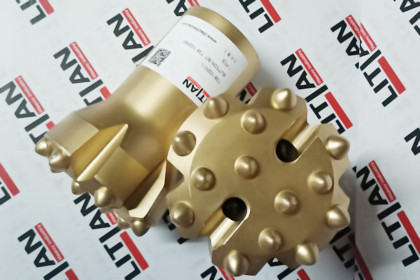
The R32 button bit is the most widely used small- to medium-diameter threaded drill bit in top hammer rock drilling. Its defining feature is the R32 rope thread, which has a nominal 32 mm major diameter and is defined under ISO 10208, the international standard for percussive rock drilling threads. This standard ensures that any R32-thread bit, rod, coupling sleeve, or shank adapter from a compliant manufacturer will physically connect—a degree of interchangeability that makes R32 the default choice for drifting, tunneling, bolting, and light production drilling worldwide.
Unlike larger thread systems (T38, T45, T51) that are built for high-power hydraulic drifters producing 18 kW and above, the R32 system was engineered for rock drills with impact power up to approximately 15 kW and hole diameters in the 38–64 mm range. R32 button bits are available in diameters from approximately 38 mm to 89 mm, with the 41–64 mm range covering the majority of production applications. Below 41 mm, the threaded connection becomes heavier than the bit head itself, reducing efficiency; above 64 mm, the R32 thread no longer provides sufficient connection stiffness for the torque and feed forces required, and operators typically step up to T38 or T45.
For a broader look at how threaded drill bits perform across all common sizes—from R32 up to T51—see the full application guide elsewhere on this site. For heavy-duty production environments requiring larger thread systems, Litian's threaded button bit range covers T38 through T51 and beyond.
The table below shows representative R32 button bit configurations covering the most commonly used diameters in drifting and tunneling. Each configuration balances button count, button diameter, face design, and flushing geometry for a specific rock condition. Lighter bits (41–45 mm, 6–7 buttons) suit bolting and face drilling where maneuverability matters; heavier configurations (51–64 mm, 8–9 buttons) are built for production drifting in abrasive ground.
| Diameter | Gauge Buttons | Front Buttons | Face Type | Approx. Weight |
| 41 mm (1 5/8") | 5 × 9 mm | 2 × 8 mm | Flat Face | 0.5 kg |
| 43 mm (1 11/16") | 6 × 9 mm | 3 × 8 mm | Flat Face | 0.7 kg |
| 45 mm (1 3/4") | 6 × 9 mm | 3 × 8 mm | Flat Face | 0.8 kg |
| 48 mm (1 7/8") | 6 × 10 mm | 3 × 8 mm | Flat Face | 0.9 kg |
| 51 mm (2") | 6 × 10 mm | 3 × 9 mm | Flat Face | 1.1 kg |
| 57 mm (2 1/4") | 6 × 11 mm | 3 × 10 mm | Flat Face | 1.3 kg |
| 64 mm (2 1/2") | 6 × 12 mm | 4 × 10 mm | Flat Face | 1.6 kg |
Gauge button diameter is the single most influential specification for bit life in abrasive rock. For R32 bits operating in sandstone, quartzite, or granite, gauge buttons of 10 mm or larger are strongly preferred. A 9 mm gauge button in highly abrasive ground can wear to the replacement threshold in roughly half the meterage of a 10 mm button under identical conditions. For example, the 45 mm R32 configuration with six 9 mm gauge buttons and three 8 mm front buttons is designed for medium-hard rock (UCS 100–180 MPa) such as dolomite or competent limestone; in high-silica granites where UCS exceeds 200 MPa, a configuration with 10 mm gauge buttons and spherical carbide inserts is the correct choice.
Flushing hole configuration also changes with diameter. Standard R32 bits use either a single central flushing hole or a combination of one central and two side holes. Side flushing holes become necessary at diameters above 48 mm, where the larger bit face generates more cuttings and needs additional airflow to clear them. Insufficient flushing in a deep hole causes regrinding of cuttings, accelerated gauge wear, and eventual bit seizure.
The carbide button shape on an R32 bit directly determines the trade-off between penetration rate and wear life. Three main button types are used:
Spherical (SB) buttons are the most common configuration for R32 bits in hard and abrasive rock. The hemispherical crown profile distributes impact stress evenly across the carbide insert, providing maximum resistance to microfracture initiation at the contact surface. In formations above approximately 180 MPa UCS—granite, quartzite, basalt—spherical button bits in hard abrasive ground reliably outlast ballistic buttons by a factor of 1.3× to 1.6× on meterage before regrinding, and they should be the default choice for any R32 bit in such conditions.
Ballistic (parabolic) buttons have a more aggressive, pointed crown profile that concentrates impact energy onto a smaller contact area for faster penetration. In soft to medium-hard rock (UCS 50–150 MPa), penetration rates can be 15–30% higher with aggressive button profiles—but the wear trade-off is real. In hard, blocky, or fractured formations, ballistic buttons are susceptible to chipping and catastrophic insert breakage.
Composite (mixed-shape) buttons mount spherical buttons on the gauge row—where wear resistance matters most—and ballistic buttons in the center. This configuration is gaining traction among contractors drilling variable ground where hole straightness and gauge retention are critical but some penetration speed is desired. The disadvantage is inventory complexity: composite bits usually need to be ordered as custom configurations rather than off-the-shelf standards.
Button grade matters as much as button shape. The dominating carbide grade for R32 gauge buttons in competitive rock conditions is YG11C (ISO K30/K40 range), which delivers hardness of approximately 86.5 HRA with transverse rupture strength (TRS) above 2,400 MPa. This combination provides the impact toughness required for high-frequency percussive drilling without sacrificing wear resistance. In extremely abrasive ground where fracture is not the dominant failure mode, a harder grade such as YG9C (hardness ≥ 88.0 HRA, lower TRS) can extend bit life, but at the cost of increased insert chipping risk in fractured formations.
R32 button bits are the standard front-end tool for tunnel face drilling with rigs such as the Atlas Copco Boomer 281/282 and Sandvik DD210/310. The compact 43–51 mm diameter range, matched with R32-H35-R38 drifter rods of 3,090–4,300 mm length, provides the maneuverability needed for pattern drilling in headings as narrow as 3.5 meters.
In tunneling, bits with rear-facing carbide inserts are standard in fractured or blocky ground. These retrac button bits cut through loose rock on extraction, preventing the bit from jamming in the hole—a problem that can stop a drilling cycle and risk losing the entire drill string.
For roof bolting in underground mines, the R32 button bit is dominant in the 41–45 mm diameter range. These light bits are mounted on R32 drifter rods and used with bolting rigs to drill holes for mechanical point-anchor bolts, resin-grouted rebar, and cable bolts. The 45 mm R32 configuration with spherical buttons at 6 × 9 mm gauge and 3 × 8 mm front is a purpose-built bolting bit, weighing 0.7–0.8 kg and balanced for the moderate impact power of bolting drifters.
In bench drilling applications where hole depths are 5–25 meters and blast hole diameters are 51–64 mm, R32 threaded bits are cost-competitive with T38 systems while being lighter on the drill string. The 51 mm R32 with 6 × 10 mm gauge buttons and three front flushing holes is a high-volume production configuration for medium-hard limestone and dolomite quarries. In silica-rich sandstone quarries where gauge wear is the dominant failure mode, operators moving from 9 mm to 10 mm gauge buttons on the same 51 mm body have documented 30–40% longer regrind intervals—a significant operational saving given that regrinding labor and grinding wheel cost are constant per bit regardless of button size.
For road construction, bridge foundation drilling, and building site preparation, R32 bits in the 45–57 mm range provide a cost-effective solution for contractors running small to medium hydraulic rigs. The ability to use the same R32 drill rods across multiple bit diameters simplifies on-site inventory and reduces the number of rod changes during a shift—a practical consideration that directly affects billed meterage per day.
Choosing the correct R32 button bit is a sequential decision-making process. The following five decisions should be made in order, because each constrains the next.
| Decision | Options | Governing Factor |
| 1. Diameter | 41–64 mm (standard R32 range) | Blast pattern design, hole volume requirement, drill rig capacity |
| 2. Button shape | Spherical / Ballistic / Composite | Rock UCS and abrasivity |
| 3. Button grade | YG11C / YG9C / YG13C | Dominant failure mode: wear vs. fracture |
| 4. Gauge button size | 9 mm / 10 mm / 11 mm / 12 mm | Abrasivity of the formation |
| 5. Face & skirt design | Flat face / Drop center / Retrac | Rock fracture density, hole straightness requirement, extraction conditions |
Gauge button diameter is the configuration choice that most directly controls bit life in abrasive rock. Moving from 9 mm to 10 mm gauge buttons on the same-diameter R32 bit can extend the regrind interval by 30–40% in high-silica formations, because the larger button retains a viable cutting profile longer as it wears. The trade-off is that fewer gauge buttons can be fitted at the bit circumference when each button is larger, and manufacturers must balance button count against button diameter to maintain the correct gauge angle and cutting profile.
The R32 thread—a rope thread profile with a nominal 32 mm major diameter—is standardized under ISO 10208, making it the only ISO-defined percussive rock drilling thread. This means that an R32-thread bit from any ISO-compliant manufacturer will physically connect to R32-thread rods, couplings, and shank adapters from any other compliant manufacturer.
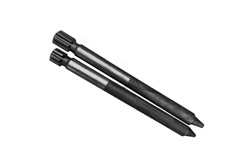
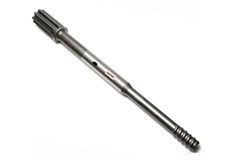
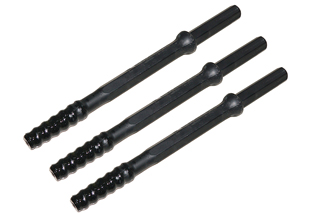
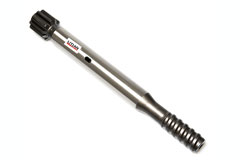
In practice, the R32 system operates with drifter rods that commonly carry a double thread configuration: an R32 male thread at the bit end and a larger thread (typically R38 or T38) at the shank end. The R38/T38-H35-R32 rod configuration—with an R32 bit-end thread and a 35 mm hex body—is the standard for drifting and tunneling worldwide. The larger shank-end thread handles the higher bending and torsional stresses near the rock drill; the lighter R32 bit-end thread keeps weight off the front of the string, reducing hole deviation in deep pattern drilling.
XR32 is a modified R32 thread profile developed to address bending failures in conventional R32 rods used with 20 kW-class drifters. The XR32 design is backward-compatible with standard R32 bits—meaning an XR32 rod can drive a standard R32 bit, and a standard R32 rod can drive an XR32 bit—while providing a stiffer connection at the bit-rod interface that reduces reflex vibration and increases thread life for both bit and rod.
Correct regrinding of button bits is essential to getting full value from an R32 tool. Operators should observe two rules:
Resharpen before excessive wear sets in: Once gauge button wear-flat width reaches approximately one-third of the button diameter, the penetration rate drops rapidly and the bit body begins contacting the rock, accelerating steel wash. Regrinding at this threshold restores the button profile and recovers most of the lost penetration rate. The regrinding operation should use a diamond grinding wheel with a cup profile matched to the original button shape, with care taken to avoid overheating the carbide—thermal stress from aggressive grinding can initiate microfractures that lead to premature insert failure on the next drilling cycle.
Retire the bit before the carbide projection height drops below the manufacturer's minimum spec: Continuing to run a bit with excessively worn buttons causes the steel body to contact the rock directly, eroding the bit face and making the bit unsafe to re-button. A bit retired at the correct projection height can often be re-buttoned and returned to service at a fraction of the cost of a new bit.
The decision to stay with R32 or move to a larger thread system depends on three factors:
| Factor | Stay with R32 | Step Up to T38/T45 |
| Hole diameter | ≤ 64 mm | > 64 mm |
| Rock drill impact power | ≤ 15 kW | > 15 kW |
| Hole depth | ≤ 20 m | > 20 m |
In production drifting with 64 mm holes and a 15 kW drifter, the R32 thread is at the upper limit of its design envelope. When hole diameters are pushed to 76 mm and beyond—or when 18–22 kW drifters are in use—the R32 thread becomes the weak point in the string, with exaggerated thread wear and an increased risk of fatigue fracture at the thread root. At this threshold, the T38 thread (or T45 for the heaviest applications) is the correct engineering choice, as the larger thread core diameter and more robust trapezoidal thread form handle the higher bending and torsional loads without excessive wear.
Operators running mixed fleets often standardize on R32 for bolting and face drilling while maintaining T38/T45 strings for production drifting—a division that allows each thread system to operate within its optimal design window while minimizing inventory complexity.
The R32 button bit occupies a specific and well-defined performance envelope: hole diameters from approximately 38 to 64 mm, rock drills with impact power up to about 15 kW, and formations ranging from soft limestone to hard abrasive granite. Five design variables—bit diameter, button shape, button grade, gauge button size, and face design—must be selected in sequence against specific rock and rig conditions. In medium-hard rock, ballistic buttons deliver the highest penetration rates. In hard abrasive ground above 180 MPa UCS, spherical buttons with YG11C-grade carbide, 10 mm or larger gauge buttons, and adequate flushing are the correct specification. When hole diameter or drifter power exceeds the R32 design limits, stepping up to T38 or T45 is the correct engineering decision. Within its design envelope—when appropriately specified for the rock, competently maintained, and reground at the correct wear-flat threshold—the R32 button bit remains the most versatile and cost-effective threaded drill bit in underground mining, tunneling, and quarrying.

Litian is a professional manufacturer focused on the production of rock drilling tools and excavation tools.
Learn More >